


Palaeolithic Flint Cordiform Hand Axe
Palaeolithic Flint Cordiform Hand Axe
Couldn't load pickup availability
Middle Palaeolithic Period, c. 50,000–40,000 BC, England
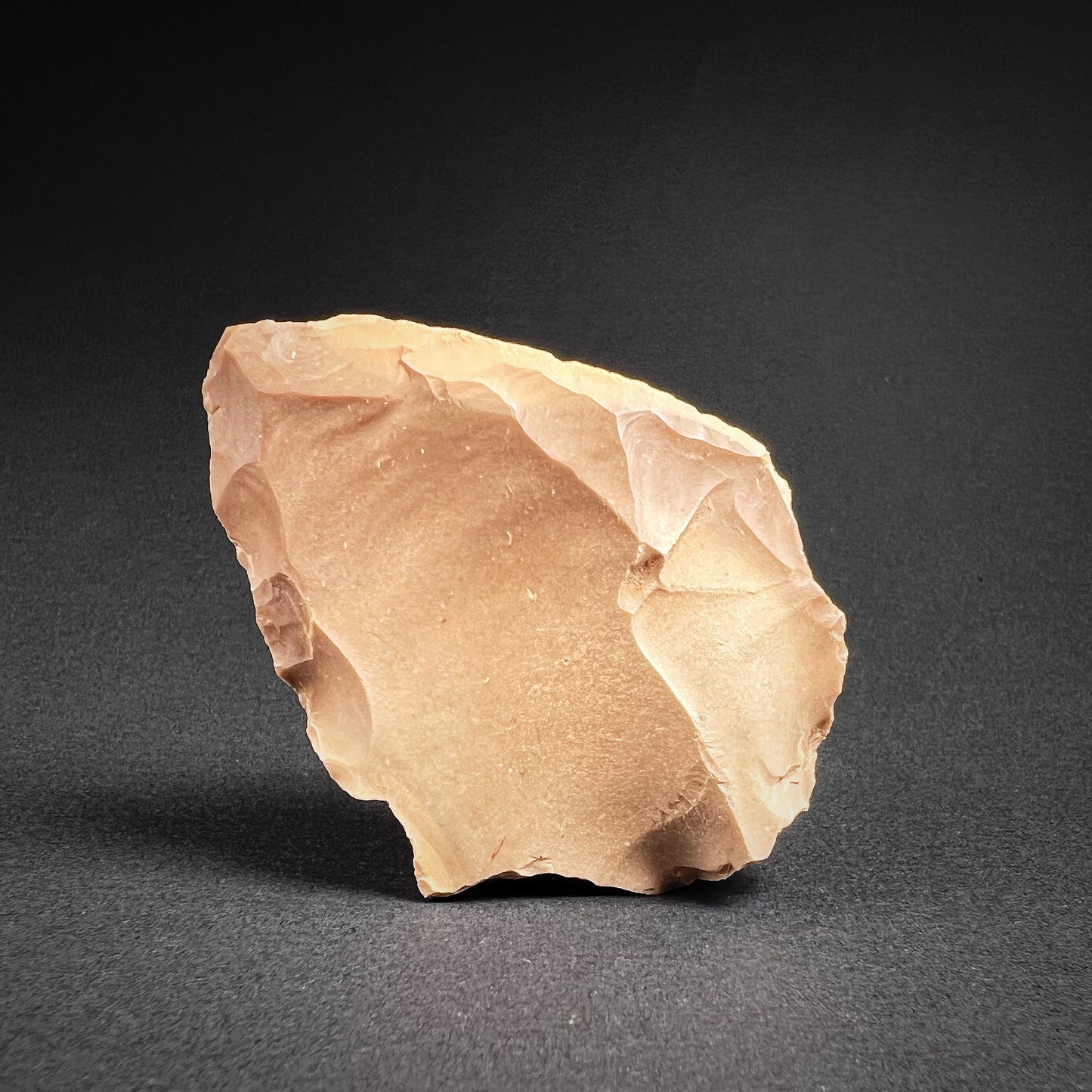
A superb and well-preserved flint hand axe dating to the Middle Palaeolithic period, displaying an attractive warm cream-white patina developed over tens of thousands of years. Expertly fashioned from a single flint nodule, the tool has been skilfully worked into a classic cordiform (heart-shaped) bifacial form, carefully shaped to fit comfortably within the hand. The finely tapered point, symmetrical profile, and expertly flaked cutting edges demonstrate the remarkable craftsmanship and technical understanding of its prehistoric maker.
The hand axe was created through the process of bifacial knapping, whereby flakes were systematically removed from both faces of the flint using a hammerstone and, during the final stages of manufacture, softer implements such as bone or antler to refine the edges. This highly effective technique produced a robust, multi-purpose tool capable of butchering game, processing hides, woodworking, and carrying out a wide variety of everyday tasks essential for survival.
Hand axes are among the most iconic artefacts of prehistoric Europe and represent one of the earliest and longest-lasting technological traditions in human history. Stone tools, spanning more than 2.6 million years, form the earliest surviving material culture of the genus Homo, providing invaluable insight into the ingenuity, adaptability, and evolving cognitive abilities of our ancient ancestors.
This elegant example belongs to the Middle Palaeolithic, a period associated in Britain primarily with Neanderthal populations, who occupied the region during warmer climatic phases before the onset of the last glacial maximum. Finds of this quality offer rare and tangible evidence of their sophisticated tool-making traditions and remarkable adaptation to the Ice Age landscapes of prehistoric Britain.
A beautifully preserved and highly evocative artefact, this flint hand axe stands as a testament to the technological achievements of early humans and offers a direct connection to one of the most significant chapters in the story of human evolution.
Good condition. Surface wear and abrasions commensurate with age, nicks and chip. Size approx. 6,5cm x 4,9cm x 1,9cm.
Provenance: Swedish private collection
For a similar examples see:
Handaxe, The British Museum, Accession Number: 1964,1206.1026 (https://www.britishmuseum.org/collection/object/H_1964-1206-1026)

-
Shipping
The shipment will be prepared in the course of 3-5 days and dispatched via Posti Group Oyj or purchased item(s) can be picked up from our shop during the store's opening hours (Tarkk’ampujankatu 4, 00140, Helsinki, Finland). Within the Finland, all items are shipped via Posti Group Oyj unless otherwise requested. We pack the items carefully and mainly in recycled materials because we want to save nature. You will receive the tracking number for your items by e-mail.
-
Returns
Returns and exchange will be accepted within fourteen days (14) of receipt at the purchaser’s cost to include freight and packaging. Items must be returned in the same condition as when they were shipped, and will not be accepted if damaged or altered in any way. Please inform us via email (info@gotanmaailma.fi) or by calling +358408408352 before sending. We do not accept returns more than 14 days after delivery.