

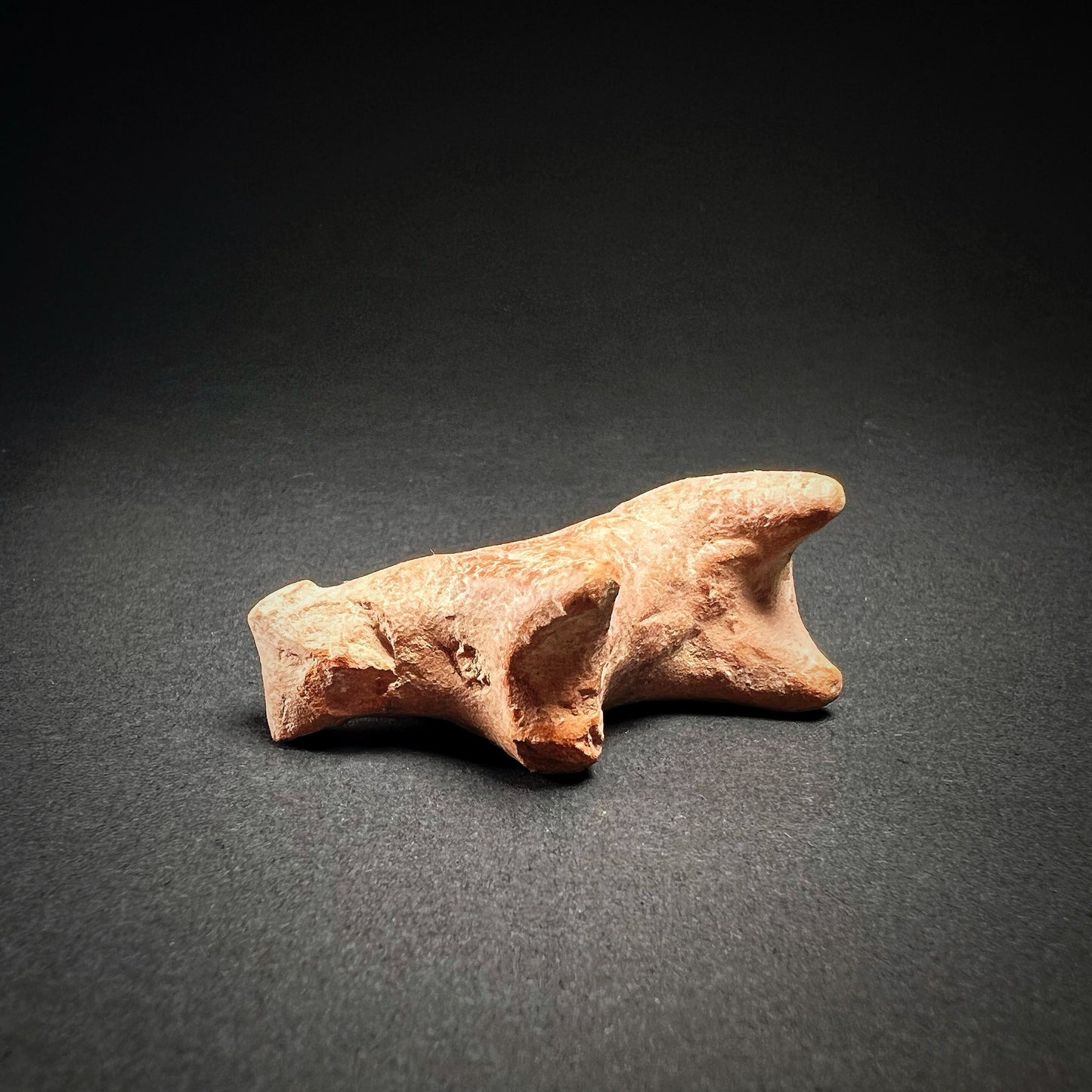
Early Harappan Terracotta Bull Figurine
Early Harappan Terracotta Bull Figurine
Couldn't load pickup availability
Early Harappan Civilization, Kot Diji Phase, c. 2800–2600 BC, Sindh, Pakistan
A rare and charming small terracotta figurine of a humped bull (Bos indicus), dating to the Kot Diji phase of the Early Harappan civilization. Hand-modeled in light red clay, the bull is immediately recognizable by its exaggerated hump, pierced with a suspension hole, rounded muzzle, and short, sturdy legs. The modeling is deliberately minimal—eyes are absent, and the ears and tail were softly indicated, though now largely lost—yet the figure retains a strong sense of character and presence. One foreleg is broken, and the extremities show wear consistent with age and handling, contributing to its authentic appearance.
Such figurines are generally interpreted as children’s toys, though they may also have served as votive objects or protective amulets. The pierced hump suggests suspension, a feature common among some of the earliest figurative objects from Harappan contexts. The zebu bull held deep economic and symbolic importance in Indus Valley society, closely associated with agriculture, strength, and fertility.
Compact, tactile, and evocative, this small sculpture offers a direct glimpse into everyday life and belief systems of one of the world’s earliest urban cultures. A rare survivor from the formative centuries of the Indus Valley tradition, it embodies both historical significance and timeless simplicity.
Good condition. Surface wear and abrasions commensurate with age, nicks and chip. Encrusted earthen deposits throughout. Size approx. 4,0cm x 1,7cm x 3,4cm
Provenance: From the estate of Professor Tore Arnborg (1912–2007), a senior United Nations official who served as head of the FAO in West and East Pakistan (now Bangladesh). Acquired abroad and brought to Sweden in the 1960s.
For a similar examples see:
Hump-Backed Bull, The Los Angeles County Museum of Art, Accession Number: AC1992.214.29 (https://collections.lacma.org/node/173747)
Figure, The British Museum, Accession Number: 1939,0619.215 (https://www.britishmuseum.org/collection/object/A_1939-0619-215?selectedImageId=1613329277)
References and further reading:
The Pakistani Collection of Terracotta Figurines in the British Museum, Irfanullah, Fazal Sher and Amjad Pervaiz, Hazara University Mansehra, Pakistan Heritage 9, 2017.
Ancient Cities of the Indus Valley Civilization, Jonathan Mark Kenoyer, Oxford University Press, 1998.
Indian Art in the Ashmolean Museum, J. C. Harle and Andrew Topsfield, Oxford: Ashmolean Museum, 1987, no. 6 on p. 6, illus. p. 6.
Early Indian art at the Ashmolean Museum - Catalogue in progress, Ahuja Naman, 2016, n. 29.1


-
Shipping
The shipment will be prepared in the course of 3-5 days and dispatched via Posti Group Oyj or purchased item(s) can be picked up from our shop during the store's opening hours (Tarkk’ampujankatu 4, 00140, Helsinki, Finland). Within the Finland, all items are shipped via Posti Group Oyj unless otherwise requested. We pack the items carefully and mainly in recycled materials because we want to save nature. You will receive the tracking number for your items by e-mail.
-
Returns
Returns and exchange will be accepted within fourteen days (14) of receipt at the purchaser’s cost to include freight and packaging. Items must be returned in the same condition as when they were shipped, and will not be accepted if damaged or altered in any way. Please inform us via email (info@gotanmaailma.fi) or by calling +358408408352 before sending. We do not accept returns more than 14 days after delivery.