


Egyptian Faience Bead Necklace
Egyptian Faience Bead Necklace
Couldn't load pickup availability
New Kingdom Period to Late Period, c. 1070–600 BC, Egypt
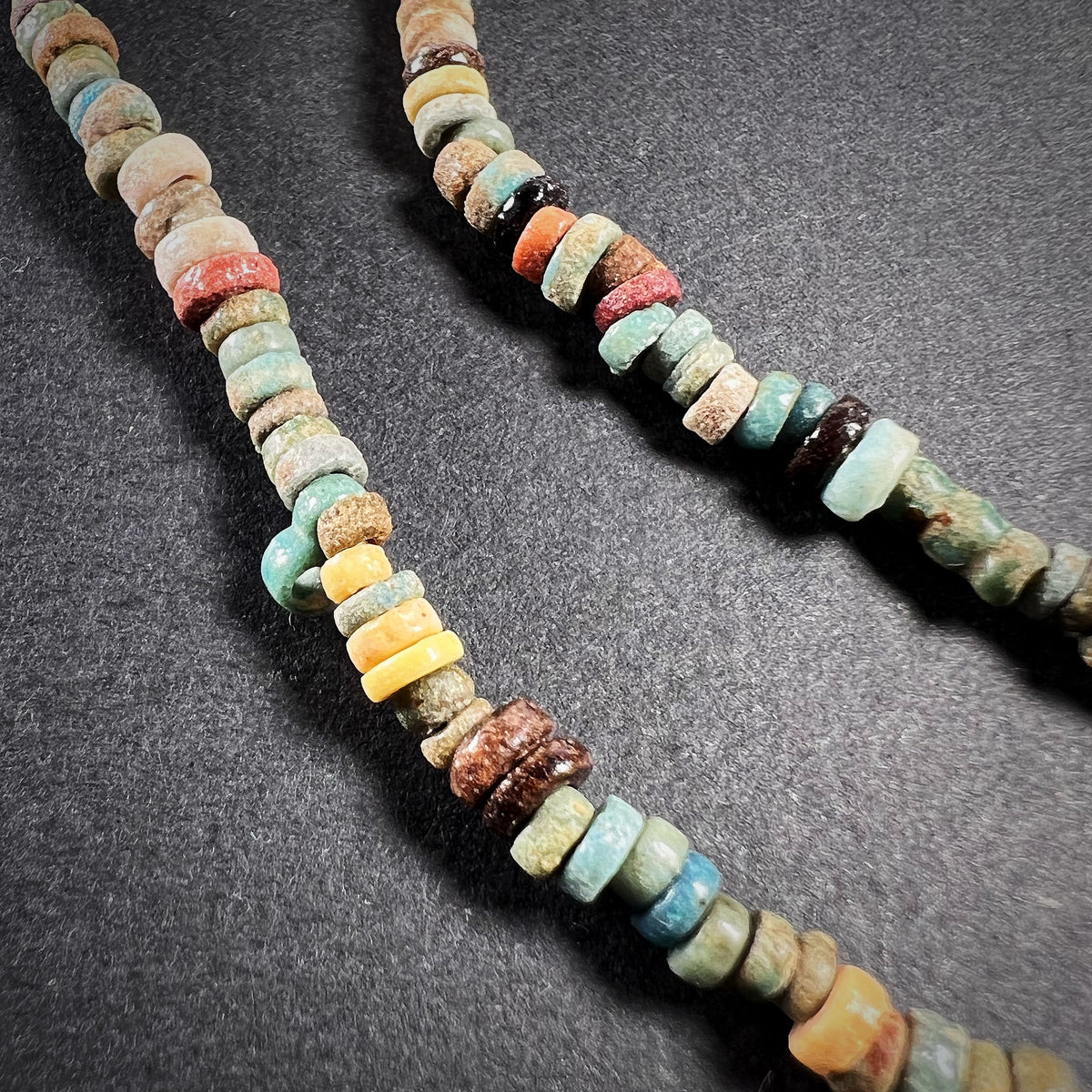
This beautiful ancient Egyptian necklace, carefully restrung for preservation, is composed of numerous small, disc-shaped faience beads arranged in a harmonious sequence of red, black, blue, brown, and white. The carefully balanced palette lends the necklace a distinctive visual richness, while the varied colours and lustrous surfaces evoke the refined artistry of ancient Egyptian personal adornment. Elegant in its simplicity, it offers an appealing example of the enduring fascination with colour, craftsmanship, and symbolic beauty in Egyptian jewellery.
Faience was one of the most characteristic materials employed by ancient Egyptian craftsmen, prized for its luminous colours and jewel-like appearance. Made primarily from finely ground quartz and finished with a lustrous alkaline glaze, it could achieve brilliant turquoise, green, and blue hues reminiscent of precious materials such as turquoise and lapis lazuli. These colours carried profound symbolic associations with fertility, regeneration, renewal, and eternal life, while contrasting shades introduced further visual interest and symbolic richness into personal ornaments.
In ancient Egypt, necklaces and other forms of jewellery were valued for far more than their decorative appeal. Faience beads were associated with protection, vitality, and regeneration, and could be worn as personal adornments during life or incorporated into funerary equipment. Their radiant surfaces and vivid colours made them particularly suited to objects believed to bridge the material and spiritual worlds, combining personal beauty with enduring hopes for protection, rebirth, and immortality.
The necklace is said to have originated from Naukratis, the important Egyptian-Greek trading settlement in the Nile Delta. Flourishing as a centre of commerce and cultural exchange, Naukratis connected Egypt with merchants and communities from across the Mediterranean. Its reported provenance therefore adds an intriguing dimension to the necklace, placing it within the wider network of trade and cultural interaction that shaped the ancient Egyptian world.
With its vivid colour scheme, delicate beadwork, and associations with ancient Egyptian beliefs, this faience necklace possesses a distinctive charm. Combining the technical sophistication of Egyptian faience production with the symbolic importance of personal adornment, it offers collectors an evocative and highly displayable piece of ancient jewellery, preserving a tangible connection to the artistry, spiritual traditions, and daily life of one of antiquity’s most enduring civilisations.
Condition: Good overall. Surface wear and abrasions consistent with age; minor chips, nicks, and attractive patina, with traces of discolouration and earthly encrustations. Length approx. 83,5 cm.
Provenance: Dutch private collection. Acquired in the 1960s.
For a similar examples see:
Necklace, The Metropolitan Museum of Art, Accession Number: 15.3.470 (https://www.metmuseum.org/art/collection/search/557476)
Bead, The British Museum, Accession Number: EA87240 (https://www.britishmuseum.org/collection/object/Y_EA87240)
Bead Necklace with a Heart Amulet Pendant, Museum of Fine Arts, Budapest, Accession Number: 51.1032 (https://www.mfab.hu/artworks/18889/)
References and further reading:
Gifts of the Nile: Ancient Egyptian Faience, Florence Dunn Friedman (ed.), London: Thames and Hudson, 1998
Egyptian Faiance: Technology and Production, Carolyn Riccardelli, Department of Objects Conservation, December 2017, The Metropolitan Museum of Art.
Ancient Technology: Faiance Beads in the Garstang Museum, Garstang Museum of Archaeology.
Ancient Egyptian Faience: An Analytical Survey of Egyptian Faience from Predynastic to Roman Times, Alexander Kaczmarczyk & Robert E. M. Hedges, Warminster: Aris & Phillips, 1983.


-
Shipping
The shipment will be prepared in the course of 3-5 days and dispatched via Posti Group Oyj or purchased item(s) can be picked up from our shop during the store's opening hours (Tarkk’ampujankatu 4, 00140, Helsinki, Finland). Within the Finland, all items are shipped via Posti Group Oyj unless otherwise requested. We pack the items carefully and mainly in recycled materials because we want to save nature. You will receive the tracking number for your items by e-mail.
-
Returns
Returns and exchange will be accepted within fourteen days (14) of receipt at the purchaser’s cost to include freight and packaging. Items must be returned in the same condition as when they were shipped, and will not be accepted if damaged or altered in any way. Please inform us via email (info@gotanmaailma.fi) or by calling +358408408352 before sending. We do not accept returns more than 14 days after delivery.