


Egyptian Faience Ushabti Fragment
Egyptian Faience Ushabti Fragment
Couldn't load pickup availability
Late Period, 26th–30th Dynasty, c. 688–332 BC, Egypt
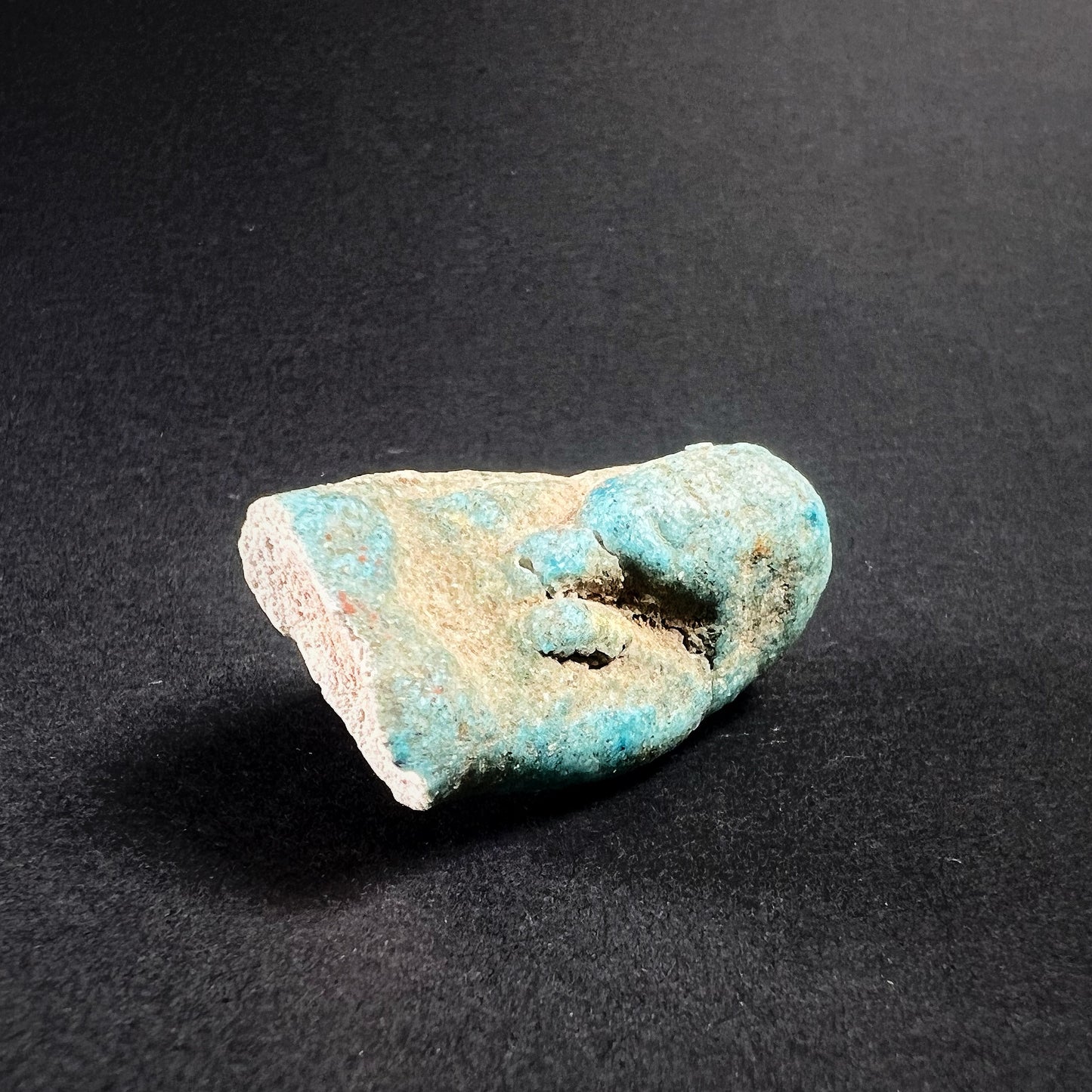
A finely moulded Egyptian faience ushabti fragment dating to the Late Period, preserving the upper portion of a mummiform funerary servant. Although the lower body has been lost in antiquity, the figure remains remarkably expressive and retains many of its original details, testifying to the skill of ancient Egyptian craftsmen.
The arms are crossed over the chest in the traditional pose, each hand holding an agricultural implement—a pick and a hoe—symbolizing the labor the ushabti was destined to perform on behalf of the deceased in the afterlife. A seed bag is suspended over the rounded shoulders, further identifying the figure as one of the eternal workers charged with cultivating the fertile "Field of Reeds," the idyllic realm of the dead ruled by Osiris.
The face is rendered with elegant simplicity, featuring elongated almond-shaped eyes with extended outer canthi, a small straight nose, softly modelled cheeks, and a rounded chin. The figure wears a curved divine beard, while the forehead is encircled by a narrow headband beneath a finely modelled tripartite wig, both characteristic features of Late Period ushabtis.
Ushabtis—also known as shabtis or shawabtis—formed an essential part of ancient Egyptian funerary equipment. They were placed within tombs to serve as magical substitutes for the deceased, answering the call to perform agricultural and other manual tasks in the afterlife. By the Late Period, burials often contained large numbers of these figures, each intended to ensure that the owner would enjoy an existence free from physical labor for eternity.
The figure is fashioned from Egyptian faience, a silica-based glazed composition made primarily from finely ground quartz with copper compounds that produced its distinctive blue or blue-green glaze. Known to the ancient Egyptians as tjehenet ("the dazzling" or "the brilliant"), faience was closely associated with rebirth, regeneration, and the life-giving waters of the Nile, making it an especially appropriate material for funerary objects.
Despite its fragmentary condition, this ushabti remains a compelling example of Late Period funerary art, embodying the religious beliefs, technical accomplishment, and enduring artistic traditions of ancient Egypt.
Good condition. Fragment as shown. Surface wear and abrasions commensurate with age, nicks and chip, with fading to some finer features, with glazing flaws and fritting. Size approx. 3,5cm x 2,1cm x 1,5cm.
Provenance: Belgian private collection


-
Shipping
The shipment will be prepared in the course of 3-5 days and dispatched via Posti Group Oyj or purchased item(s) can be picked up from our shop during the store's opening hours (Tarkk’ampujankatu 4, 00140, Helsinki, Finland). Within the Finland, all items are shipped via Posti Group Oyj unless otherwise requested. We pack the items carefully and mainly in recycled materials because we want to save nature. You will receive the tracking number for your items by e-mail.
-
Returns
Returns and exchange will be accepted within fourteen days (14) of receipt at the purchaser’s cost to include freight and packaging. Items must be returned in the same condition as when they were shipped, and will not be accepted if damaged or altered in any way. Please inform us via email (info@gotanmaailma.fi) or by calling +358408408352 before sending. We do not accept returns more than 14 days after delivery.