

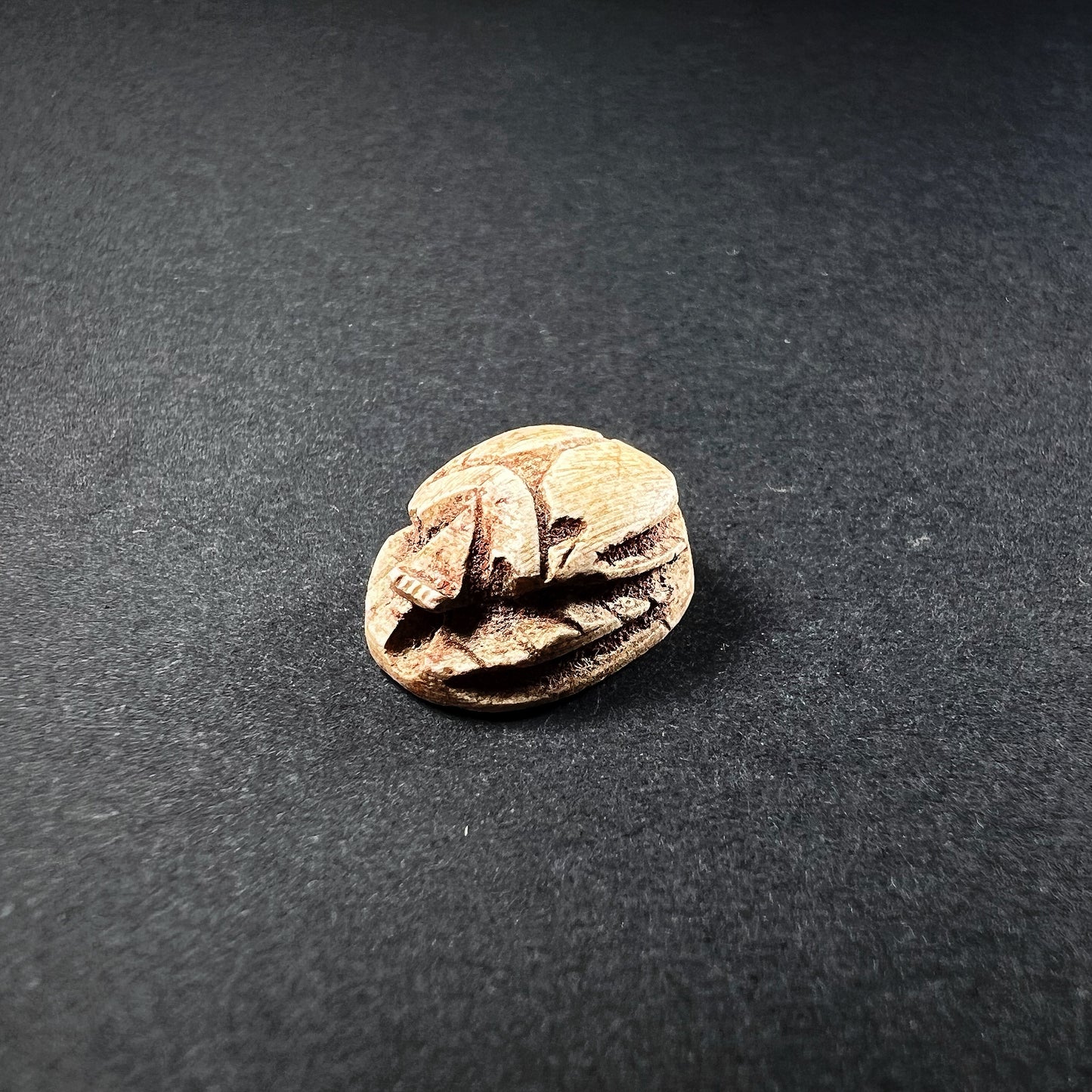
Egyptian Steatite Scarab
Egyptian Steatite Scarab
Couldn't load pickup availability
Thutmose III Reign, 18th Dynasty, New Kingdom of Egypt, c. 1400–700 BC
An attractive small Egyptian steatite scarab, finely carved with remarkable attention to detail despite its diminutive size. The upper surface displays a carefully rendered beetle with a well-defined clypeus and head, while delicately incised lines define the prothorax and elytra, creating a balanced and naturalistic representation of the sacred scarab beetle.
The underside is intricately engraved with hieroglyphic motifs, including a standing figure, possibly falcon-headed and representing the god Horus. Above the figure appears a solar disk associated with Ra, while a šw feather is positioned to the side, forming a symbolic composition linked to divine protection, kingship, and solar regeneration. The scarab has been pierced longitudinally for suspension, allowing it to be worn as an amulet or mounted in a piece of jewelry.
Scarabs of this type became especially popular during the New Kingdom and remained in use for centuries thereafter. They functioned as personal seals, protective amulets, and devotional objects, often bearing royal names, religious symbols, or auspicious inscriptions. The continued production and circulation of scarabs long after the reigns they commemorated reflects their enduring symbolic importance within Egyptian society.
In ancient Egyptian belief, the scarab beetle (Scarabaeus sacer) was revered as a symbol of rebirth, renewal, and the eternal cycle of life. Observing the beetle rolling balls of dung across the ground, the Egyptians associated its movements with the daily journey of the sun across the heavens. This connection linked the insect to the god Khepri, the divine manifestation of the rising sun and a powerful symbol of creation and transformation.
Among the most iconic and enduring forms of Egyptian material culture, scarabs were widely employed in both daily life and funerary contexts. This finely engraved example is a charming testament to the religious beliefs, artistic skill, and symbolic sophistication of ancient Egypt, combining intricate craftsmanship with profound spiritual significance.
Good condition to the obverse and reverse. Surface wear and abrasions commensurate with age, with chips, nicks and abrasion, with fading to some finer features, and light encrustations within recessed areas. Nice earthen deposits throughout. Please note the small dimensions of this scarab. Size approx. 1,9cm x 1,2cm x 0,7cm.
Provenance: Dutch private collection


-
Shipping
The shipment will be prepared in the course of 3-5 days and dispatched via Posti Group Oyj or purchased item(s) can be picked up from our shop during the store's opening hours (Tarkk’ampujankatu 4, 00140, Helsinki, Finland). Within the Finland, all items are shipped via Posti Group Oyj unless otherwise requested. We pack the items carefully and mainly in recycled materials because we want to save nature. You will receive the tracking number for your items by e-mail.
-
Returns
Returns and exchange will be accepted within fourteen days (14) of receipt at the purchaser’s cost to include freight and packaging. Items must be returned in the same condition as when they were shipped, and will not be accepted if damaged or altered in any way. Please inform us via email (info@gotanmaailma.fi) or by calling +358408408352 before sending. We do not accept returns more than 14 days after delivery.