

Egyptian Steatite Scarab
Egyptian Steatite Scarab
Couldn't load pickup availability
18th-19th Dynasty, New Kingdom of Egypt, Ramesside period c. 1570–1185 BC
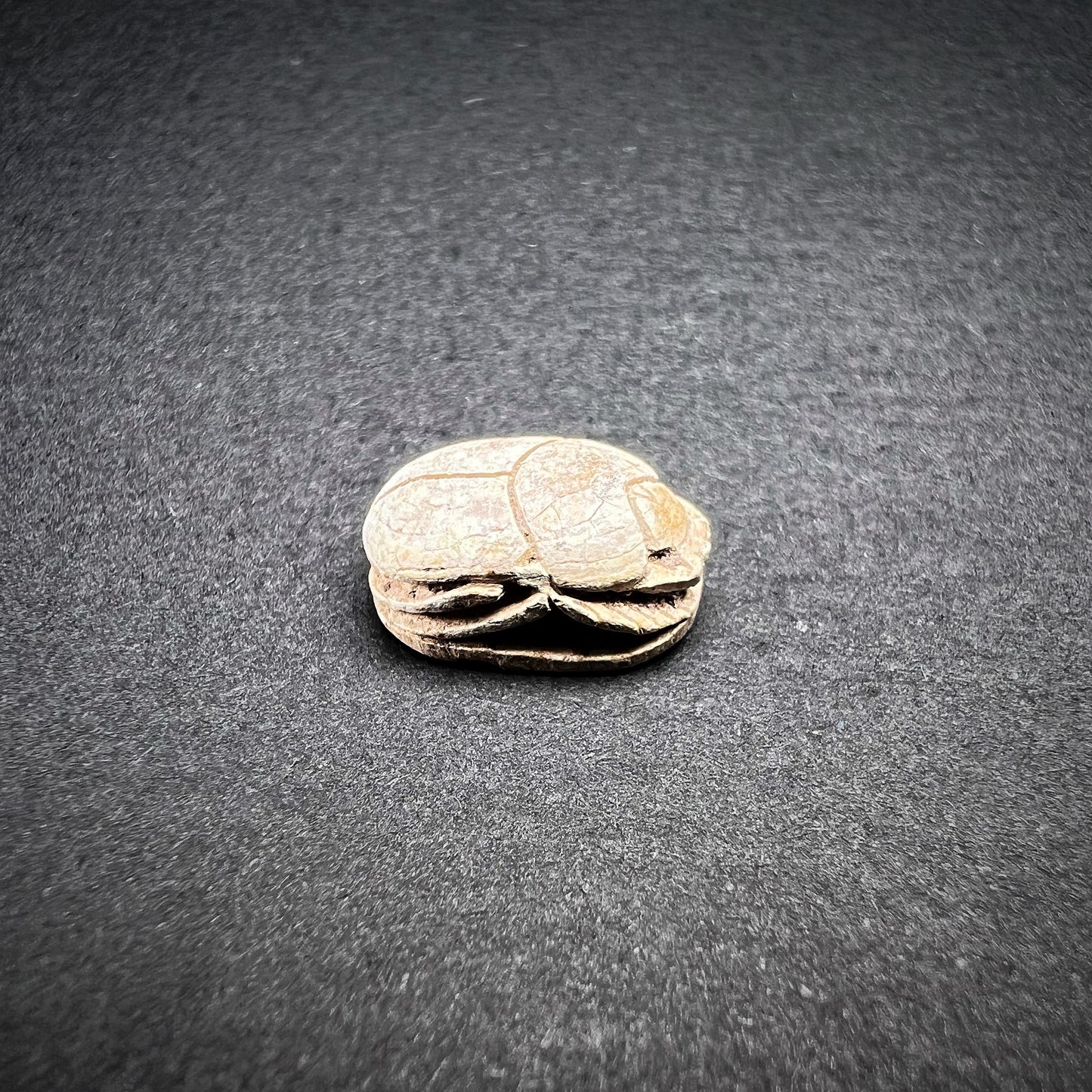
A beautiful and finely carved Egyptian steatite scarab of small size, executed with remarkable precision and attention to detail. The upper surface is carefully modelled in the form of the sacred scarab beetle, with a clearly defined clypeus and head, while delicately incised lines distinguish the prothorax and elytra, giving the insect a naturalistic and harmonious appearance.
The underside bears a finely engraved hieroglyphic composition enclosed within an oval border. From left to right, the design incorporates several important Egyptian signs. At the far left is the Neb sign, depicting a shallow bowl or basket traditionally associated with the concepts of “lord” or “all.” Beside it is the Nefer sign, recognizable by its distinctive looped form resting upon a horizontal base. Meaning “beautiful,” “good,” “pleasant,” or “perfect,” nefer was frequently used in amuletic contexts as an auspicious expression of well-being, prosperity, and good fortune.
Opposite the nefer sign is a rearing uraeus cobra, its hood raised in a characteristic defensive posture. The cobra represents the protective goddess Wadjet, one of the most important divine guardians in ancient Egyptian religion. At the far right is the Djed pillar, an ancient symbol associated with stability, permanence, and enduring strength. Together, these signs create a compact but richly symbolic composition, combining ideas of protection, prosperity, stability, and divine favour.
The finely rendered anatomy of the beetle, particularly the pronounced humeral callosities and crisp linear carving, is characteristic of scarabs produced during the New Kingdom. Such anatomical details are generally absent from earlier examples and became increasingly refined from the 18th Dynasty onward, continuing through the Ramesside period. The quality of the engraving reflects the considerable skill of the Egyptian craftsmen responsible for these small yet highly significant objects.
The scarab beetle (Scarabaeus sacer) was among the most powerful and enduring religious symbols of ancient Egypt, representing rebirth, regeneration, and the perpetual cycle of existence. The Egyptians observed the beetle rolling balls of dung across the ground and associated this mysterious act with the daily movement of the sun across the heavens. This connection linked the scarab to Khepri, the divine manifestation of the rising sun and a powerful symbol of creation, renewal, and transformation.
The hieroglyphic imagery on Egyptian scarabs could likewise invoke divine protection and auspicious qualities. Protective deities such as Wadjet played an important role in safeguarding both individuals and the king, while the nefer and Djed signs expressed desirable qualities of goodness, prosperity, stability, and enduring life. Scarabs could therefore function simultaneously as personal ornaments, seals, amulets, and objects of devotion.
Both a beautiful piece of personal adornment and a powerful protective object, this finely engraved scarab offers a remarkable combination of artistic refinement and religious symbolism. Its detailed beetle carving and carefully composed hieroglyphic reverse make it an evocative example of New Kingdom Egyptian craftsmanship and a tangible connection to the spiritual world of ancient Egypt.
Excellent condition to the obverse and reverse. Surface wear and abrasions commensurate with age, with fading to some finer features, and light encrustations within recessed areas. Please note the small dimensions of this scarab. Size approx. 1,2cm x 0,8cm x 0,6cm.
Provenance: From the collection of Stig Regnell. Acquired abroad and brought to Sweden during the 1960s. Previously in the collection of Mr. H. Khattab, 11 Mariette Pasha Street, Cairo.


-
Shipping
The shipment will be prepared in the course of 3-5 days and dispatched via Posti Group Oyj or purchased item(s) can be picked up from our shop during the store's opening hours (Tarkk’ampujankatu 4, 00140, Helsinki, Finland). Within the Finland, all items are shipped via Posti Group Oyj unless otherwise requested. We pack the items carefully and mainly in recycled materials because we want to save nature. You will receive the tracking number for your items by e-mail.
-
Returns
Returns and exchange will be accepted within fourteen days (14) of receipt at the purchaser’s cost to include freight and packaging. Items must be returned in the same condition as when they were shipped, and will not be accepted if damaged or altered in any way. Please inform us via email (info@gotanmaailma.fi) or by calling +358408408352 before sending. We do not accept returns more than 14 days after delivery.