


Yoruba or Wurkun Figural Staff
Yoruba or Wurkun Figural Staff
Couldn't load pickup availability
Yoruba or Wurkun people, early 20th century, Nigeria, West Africa
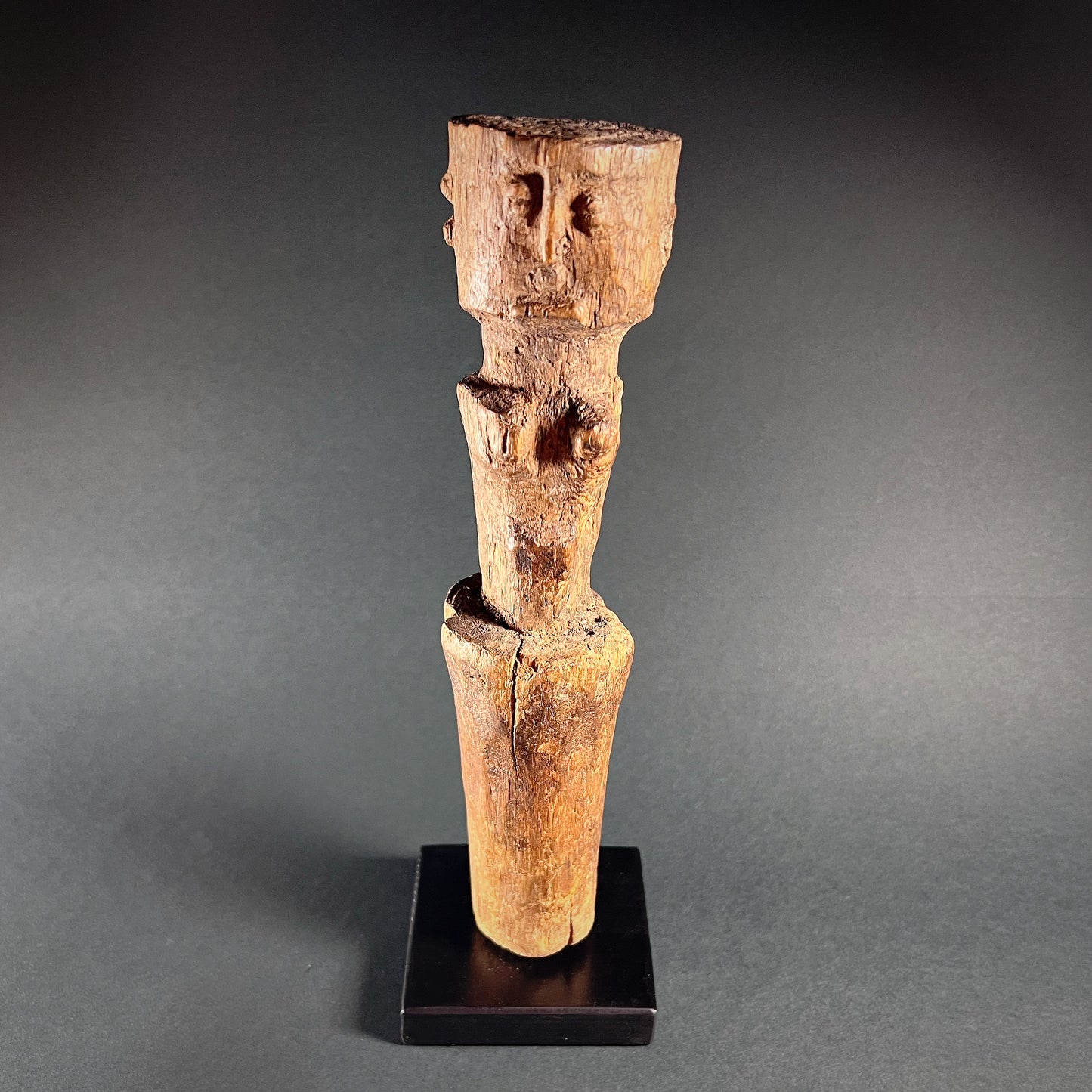
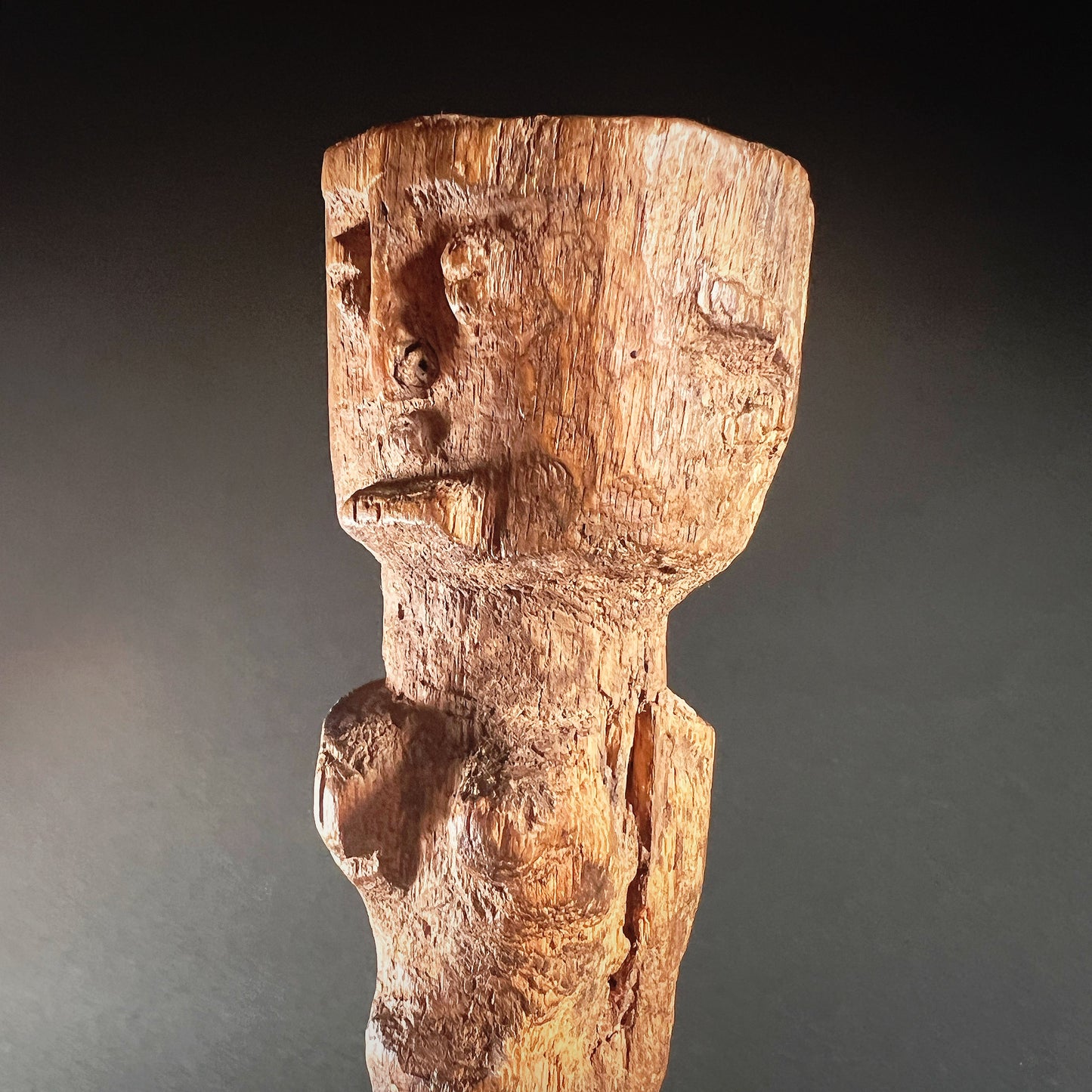
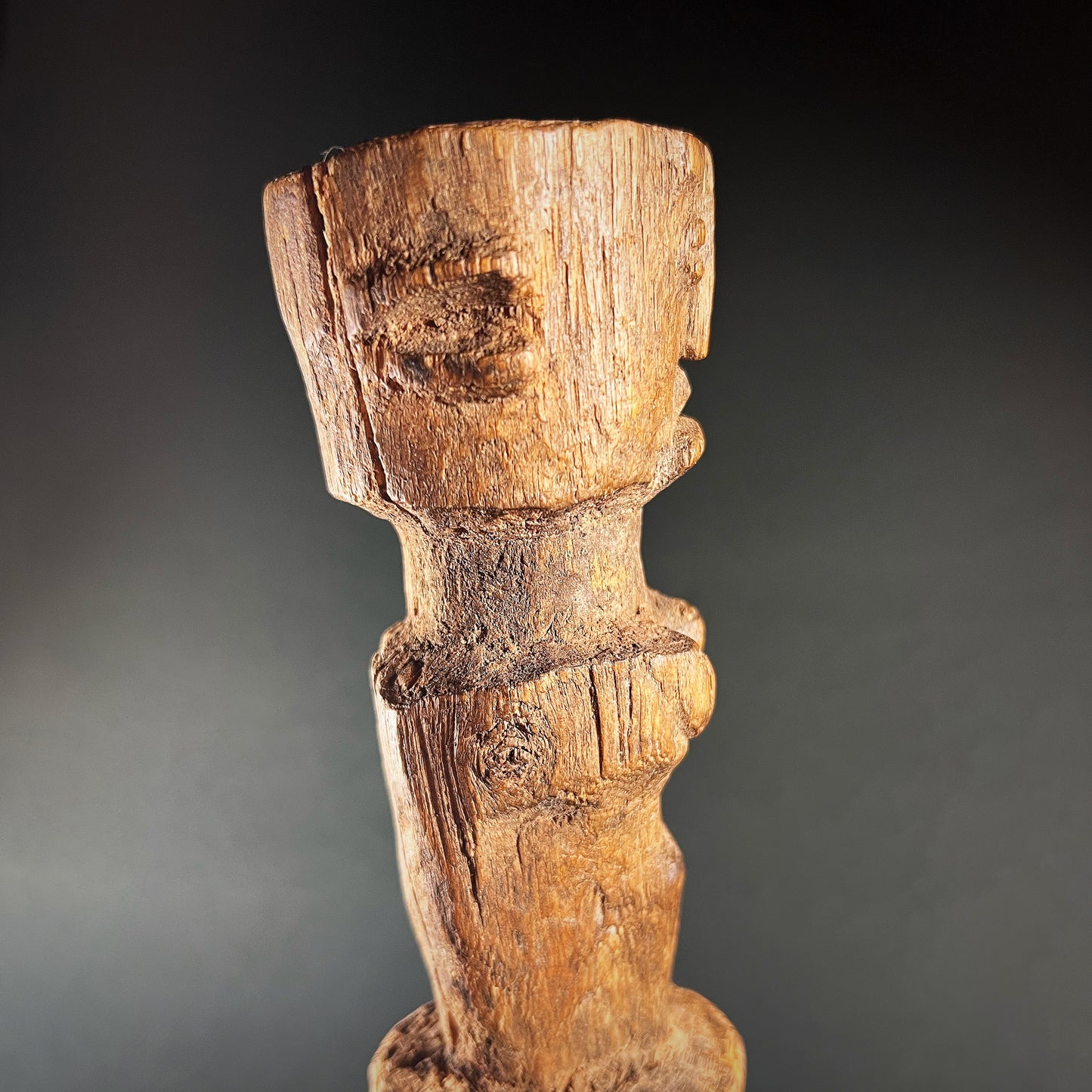
Fascinating and boldly carved fragment of a processional staff, displaying powerful presence despite its weathered condition. The form consists of a sturdy conical pillar surmounted by a female figure—possibly a priestess—rendered in a strikingly abstract and highly stylized manner. The head is sharply geometric, with ears, nose, and mouth simplified into angular, almost architectural shapes. The thick neck rests upon rounded shoulders, while the cylindrical torso bears clearly indicated breasts and navel. The bent arms, once resting on the lower abdomen, are now heavily worn.
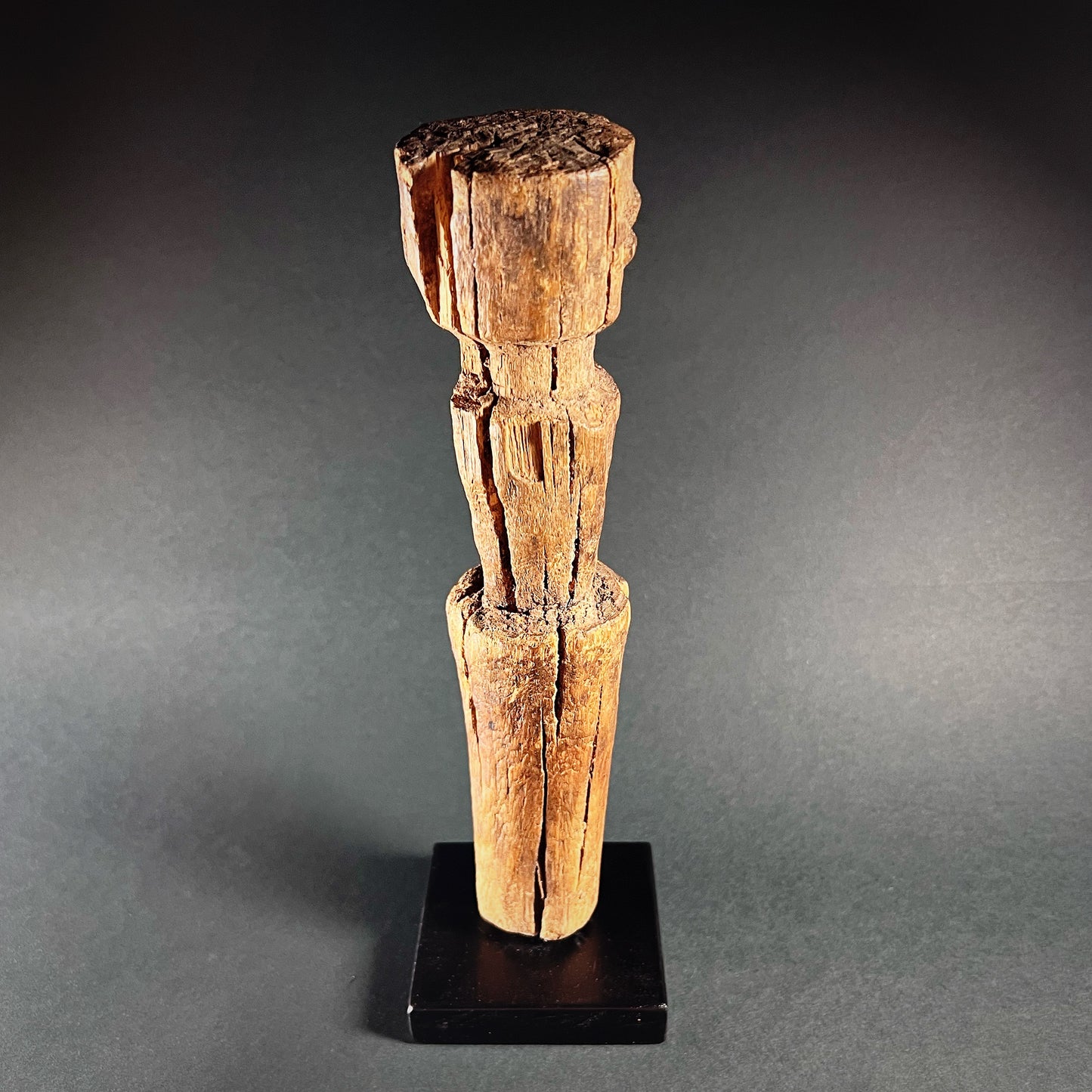
The entire figure shows extensive insect erosion, which has sculpted deep cavities and contributed to the object's current imbalance. Traces of sacrificial libations remain visible, attesting to the staff’s ritual history and active ceremonial use.
The Yoruba inhabit southwestern Nigeria as well as parts of Benin, Togo, and Ghana. Their religious system (Ìṣẹ̀ṣe) recognizes a supreme creator—Olodumare / Olorun—and an expansive pantheon of intermediary deities (Orisa), each governing specific natural forces and human concerns. Yoruba cosmology, foundational to New World religions such as Santería, Candomblé, Haitian Vodou, Umbanda, and Trinidad Orisha, teaches that upon death, every soul confesses its earthly deeds before Olodumare and is sent either to the Good Heaven (Ọ̀run Rere) or the Bad Heaven (Ọ̀run Buburu). Among the most prominent Orisa are Oya (wind and storms), Ifa (divination and fate), Osanyin (medicines), Osun (fertility and motherhood), Sango (thunder), and Ibeji (twins).
The term Wurkun does not refer to a single ethnic group but is instead a broad classification encompassing several hill-dwelling communities—including the Kulung, Piya, Kwanci, and Kode—who live in the rugged western Muri Mountains. The name Wurkun, of Jukun origin, simply means “people of the hills.”
A compelling, spiritually charged sculptural fragment, rich in ceremonial character and bearing the powerful visual language of either Yoruba or Wurkun artistic traditions.
Surface wear and abrasions commensurate with age and use. Cracks and fractures. Size approx. 26,0cm x 5,8cm x 5,8cm (excluding the modern base).
Provenance: Swedish private collection
References and further reading:
Encyclopedia of the Ibeji, Fausto Polo, Ibeji Art, 2008.
The Historiography of Yoruba Myth and Ritual, Andrew Apter, History in Africa, Vol. 14, 1987, Published by Cambridge University Press, pp. 1-25.
The Yoruba, Art & Life in Africa, University of Iowa Stanley Museum of Art.
The Study of Yoruba Religious Tradition in Historical Perspective, Jacob K. Olupona, Numen, Vol. 40, No. 3, Sep., 1993, pp. 240-273.
Art of the Yoruba, Moyo Okediji, Art Institute of Chicago Museum Studies, Vol. 23, No. 2, African Art at The Art Institute of Chicago (1997), pp. 164-181+198.
Ibeji Images of the Yoruba, Marilyn Hammersley Houlberg, African Arts, Vol. 7, No. 1, Autumn 1973, Published by UCLA James S. Coleman African Studies Center, pp. 20-27+91-92.
-
Shipping
The shipment will be prepared in the course of 3-5 days and dispatched via Posti Group Oyj or purchased item(s) can be picked up from our shop during the store's opening hours (Tarkk’ampujankatu 4, 00140, Helsinki, Finland). Within the Finland, all items are shipped via Posti Group Oyj unless otherwise requested. We pack the items carefully and mainly in recycled materials because we want to save nature. You will receive the tracking number for your items by e-mail.
-
Returns
Returns and exchange will be accepted within fourteen days (14) of receipt at the purchaser’s cost to include freight and packaging. Items must be returned in the same condition as when they were shipped, and will not be accepted if damaged or altered in any way. Please inform us via email (info@gotanmaailma.fi) or by calling +358408408352 before sending. We do not accept returns more than 14 days after delivery.