


Fulani Bronze Anklet Currency (Manilla)
Fulani Bronze Anklet Currency (Manilla)
Couldn't load pickup availability
Fulani people, early to mid-20th century, Nigeria
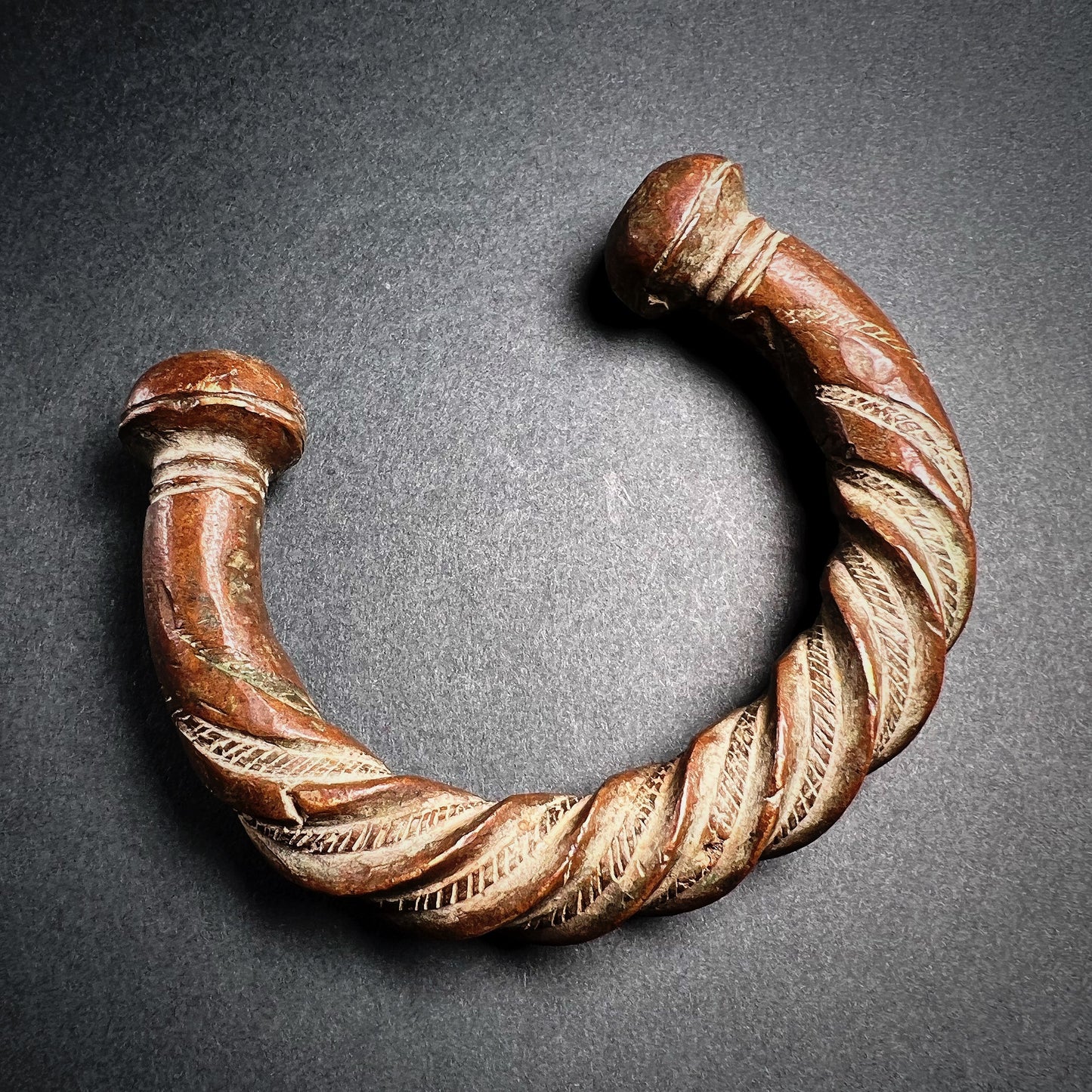
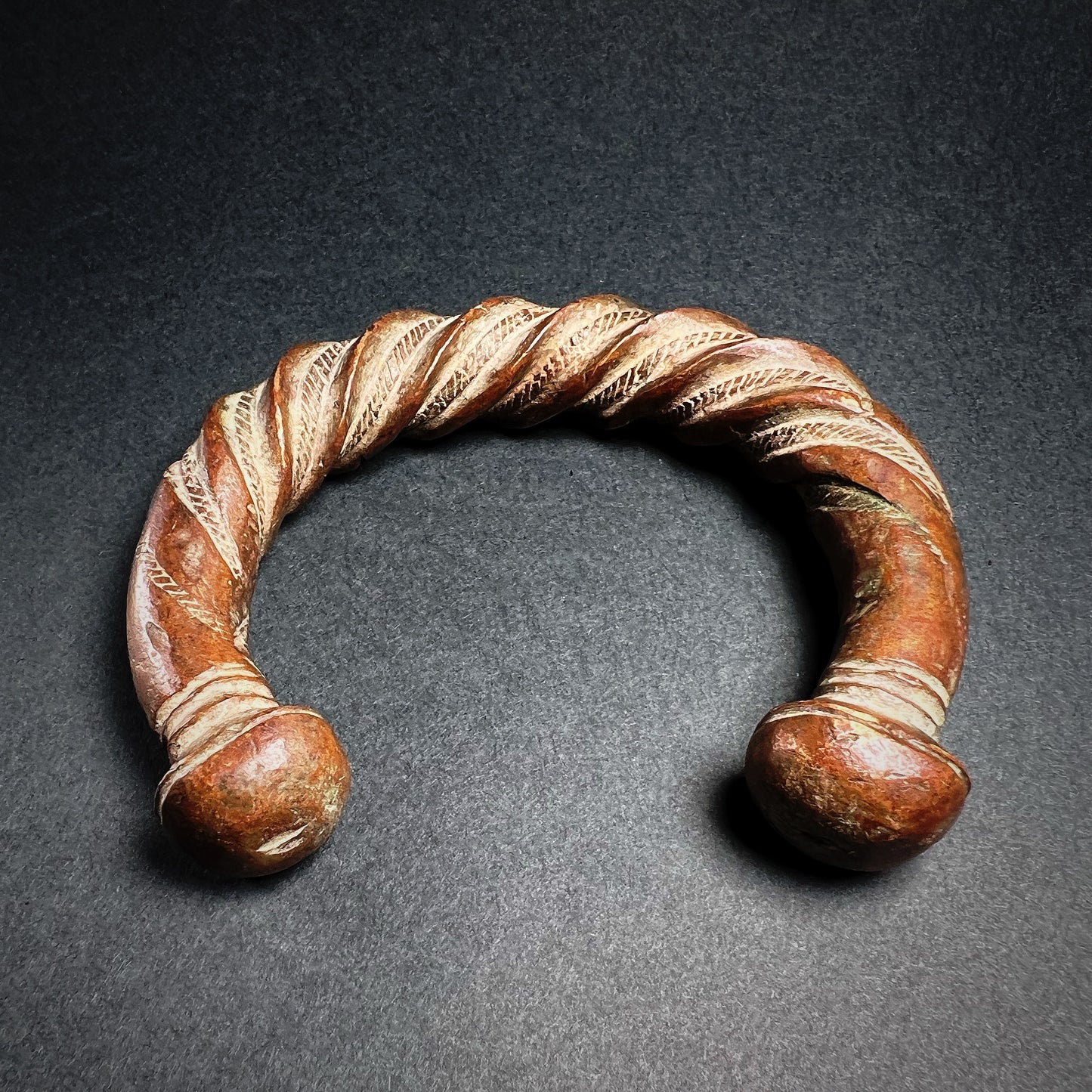
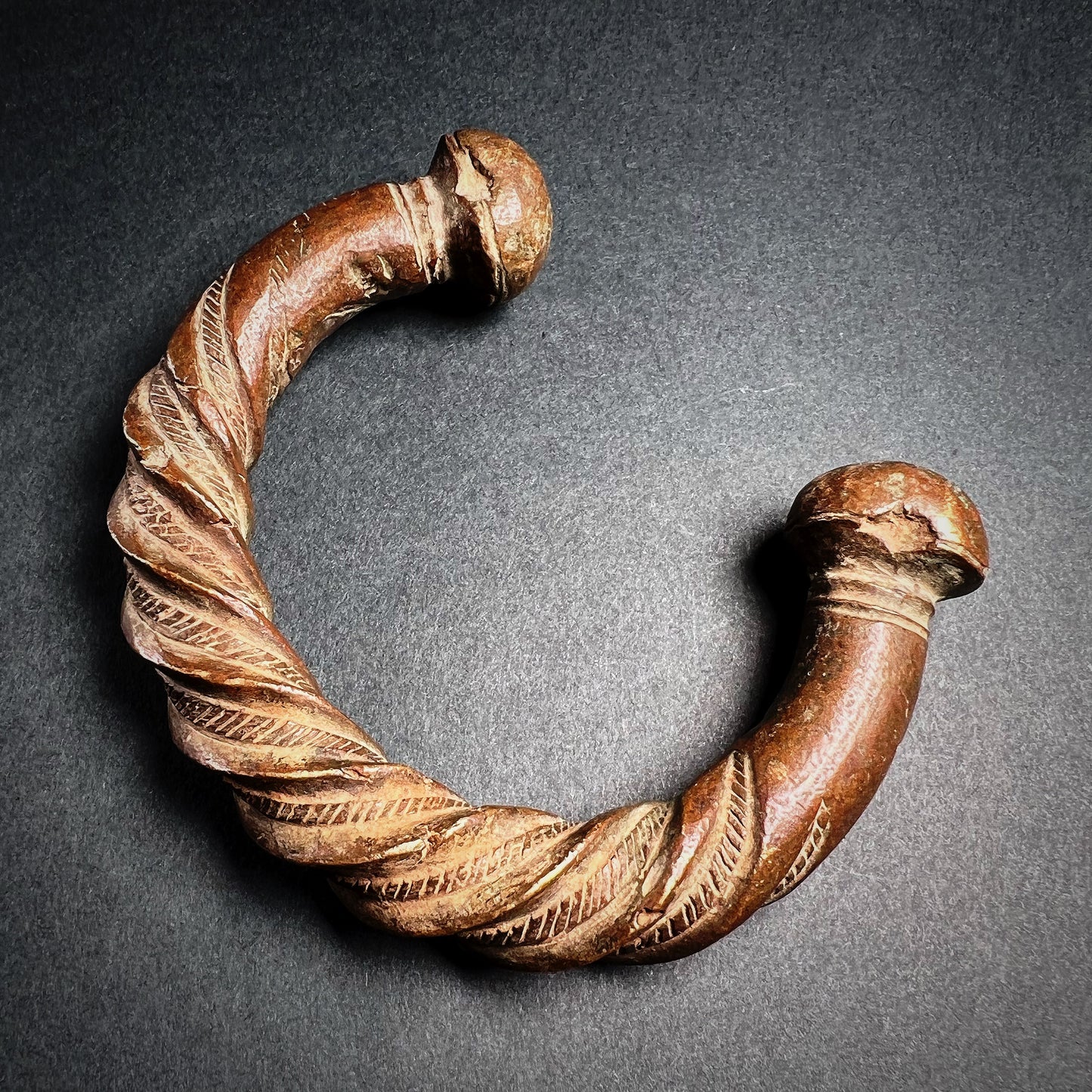
Magnificent cast bronze anklet currency piece with the classic U-shaped form, created using the lost-wax method and richly adorned with intertwined, twisted strands. The terminals are neatly incised with circular motifs, adding refined decorative detail. Thick, weighty, and beautifully balanced, this woman’s anklet would have produced a graceful sway in movement—both a striking ornament and a functional store of wealth.
The Fulani (Fulɓe) are one of Africa’s most widespread ethnic groups, inhabiting regions across the Sahara, Sahel, and West Africa. While many Fulani are pastoralists—forming the largest nomadic herding community in the world—the broader society includes settled farmers, artisans, merchants, scholars, and nobility. Across these diverse communities, personal adornment holds a longstanding cultural importance. Fulani women have historically favored bold jewelry forms, particularly bronze bracelets and anklets shaped like horseshoes with decorated terminals. Such ornaments were not only beautiful but practical: wearable currency that could be carried effortlessly across long distances, serving as wealth, status, and readily exchangeable value.
This anklet belongs to the broader tradition of manillas, a form of bronze or copper commodity money long used throughout West Africa. Produced in a wide variety of shapes and sizes, manillas predate colonial contact and continued in circulation until the late 1940s, though they remain valued as decorative objects today. Their name may derive from Spanish manilla (“bracelet”), Portuguese manilha (“hand-ring”), the Latin manus (“hand”), or monilia (“necklaces”). Typically horseshoe-shaped with flaring terminals, they served as adornment, trade goods, and ritual wealth.
Historically, manillas played a major role in regional economies, particularly in southern Nigeria. In the 16th century trading center of Calabar, well-established values were already in place: around 1505 a slave could be purchased for 8–10 manillas, while a large elephant tusk could be traded for one copper manilla. Each region recognized and valued different types, often with highly specific preferences regarding form and weight.
With its elaborate twisted design, fine casting, and deep, aged patina, this superb Fulani manilla stands out as both an authentic piece of traditional currency and a powerful sculptural object. A remarkable example of West African metal artistry and mobile wealth.
Good condition. Wear consistent with age and use. Size approx. 9,8cm x 8,0cm x 2,0cm.
Provenance: Private collection, Morocco.
References and further reading:
The Teach Yourself Guide to Numismatics, C.C. Chamberlain, English Universities Press. 1963, p. 92.
The West African Manilla Currency: Research and Securing of Evidence from 1439-2019, Rolf Denk, Tredition GmbH, Hamburg, 2020.
Primitive Money in its ethnological, historical and economic aspects, Paul Einzig, Eyre & Spottiswoode, London, 1949.
Object biographies, Manilla or Penannular Bracelet Currency, Eric Edwards, Balfour Library, Pitt Rivers Museum, January 29th, 2010. (https://web.prm.ox.ac.uk/rpr/index.php/objectbiographies/78-manilla.html)
-
Shipping
The shipment will be prepared in the course of 3-5 days and dispatched via Posti Group Oyj or purchased item(s) can be picked up from our shop during the store's opening hours (Tarkk’ampujankatu 4, 00140, Helsinki, Finland). Within the Finland, all items are shipped via Posti Group Oyj unless otherwise requested. We pack the items carefully and mainly in recycled materials because we want to save nature. You will receive the tracking number for your items by e-mail.
-
Returns
Returns and exchange will be accepted within fourteen days (14) of receipt at the purchaser’s cost to include freight and packaging. Items must be returned in the same condition as when they were shipped, and will not be accepted if damaged or altered in any way. Please inform us via email (info@gotanmaailma.fi) or by calling +358408408352 before sending. We do not accept returns more than 14 days after delivery.