

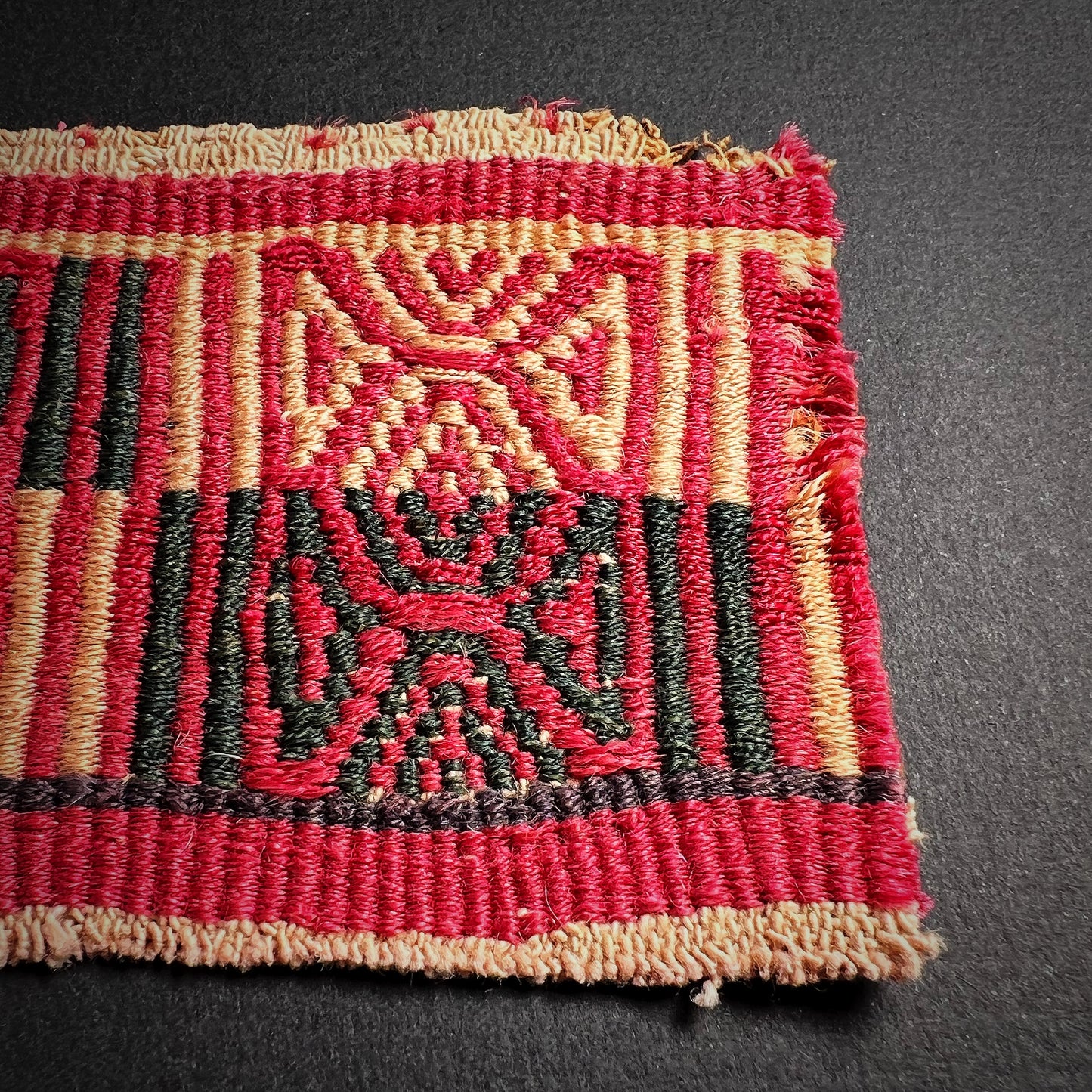
Inca Textile Fragment
Inca Textile Fragment
Couldn't load pickup availability
Pre-Columbian Era, Inca Empire, Late Horizon, c. 1400–1532 AD, Central Coast Peru
A mesmerizing textile fragment comprising a rectangular panel of finely woven cloth, exemplifying the extraordinary technical mastery and aesthetic sophistication of Inca weaving traditions. Such fragments once formed parts of larger garments, including tunics (unkus), coca bags (chuspas), or ceremonial belts (chumpis). The composition is organized into a series of carefully arranged geometric squares, known as tocapus, highly structured motifs believed to have functioned as a sophisticated visual language associated with the imperial elite, conveying identity, rank, or administrative affiliation.
Woven from finely spun camelid fibres—most likely alpaca or llama wool—and possibly incorporating cotton warps, the textile demonstrates an exceptionally dense and accomplished weaving technique. It was likely produced on a traditional backstrap loom, a portable device capable of achieving the remarkable precision required for complex geometric designs. The tightly executed weave suggests a high-quality qompi (also known as cumbi) textile, the finest class of cloth produced in the Inca Empire and reserved for royalty, nobility, and religious offerings.
The vibrant palette comprises rich reds, creamy whites, ochres, moss greens, and deep indigo blues. These colours were derived entirely from natural sources available throughout the Andes, including mineral pigments, native plants, and cochineal insects. Thanks to the exceptionally arid conditions of coastal Peru, Andean textiles often survive in remarkable condition; this example is particularly well preserved, retaining crisp geometric ornamentation and vivid original colours.
Textiles occupied a central place within Inca society and ranked among the empire's most prized artistic and economic resources. Far more valuable than precious metals, fine woven cloth functioned as a symbol of status, an instrument of diplomacy, a form of tribute, and an essential component of religious ceremony. Throughout the Late Horizon, increasingly sophisticated geometric and symbolic compositions reflected the administrative complexity and cultural achievements of the expanding Inca state.
A visually striking and historically important fragment, this textile embodies the exceptional artistry, technical ingenuity, and symbolic richness of the Inca weaving tradition, offering a rare and tangible connection to one of the greatest civilizations of the ancient Americas.
Excellent condition. Intact. Surface wear and abrasions commensurate with age and use. Loose threads. Size approx. 21,2cm x 7,2cm.
Provenance: Swedish private collection.


-
Shipping
The shipment will be prepared in the course of 3-5 days and dispatched via Posti Group Oyj or purchased item(s) can be picked up from our shop during the store's opening hours (Tarkk’ampujankatu 4, 00140, Helsinki, Finland). Within the Finland, all items are shipped via Posti Group Oyj unless otherwise requested. We pack the items carefully and mainly in recycled materials because we want to save nature. You will receive the tracking number for your items by e-mail.
-
Returns
Returns and exchange will be accepted within fourteen days (14) of receipt at the purchaser’s cost to include freight and packaging. Items must be returned in the same condition as when they were shipped, and will not be accepted if damaged or altered in any way. Please inform us via email (info@gotanmaailma.fi) or by calling +358408408352 before sending. We do not accept returns more than 14 days after delivery.