

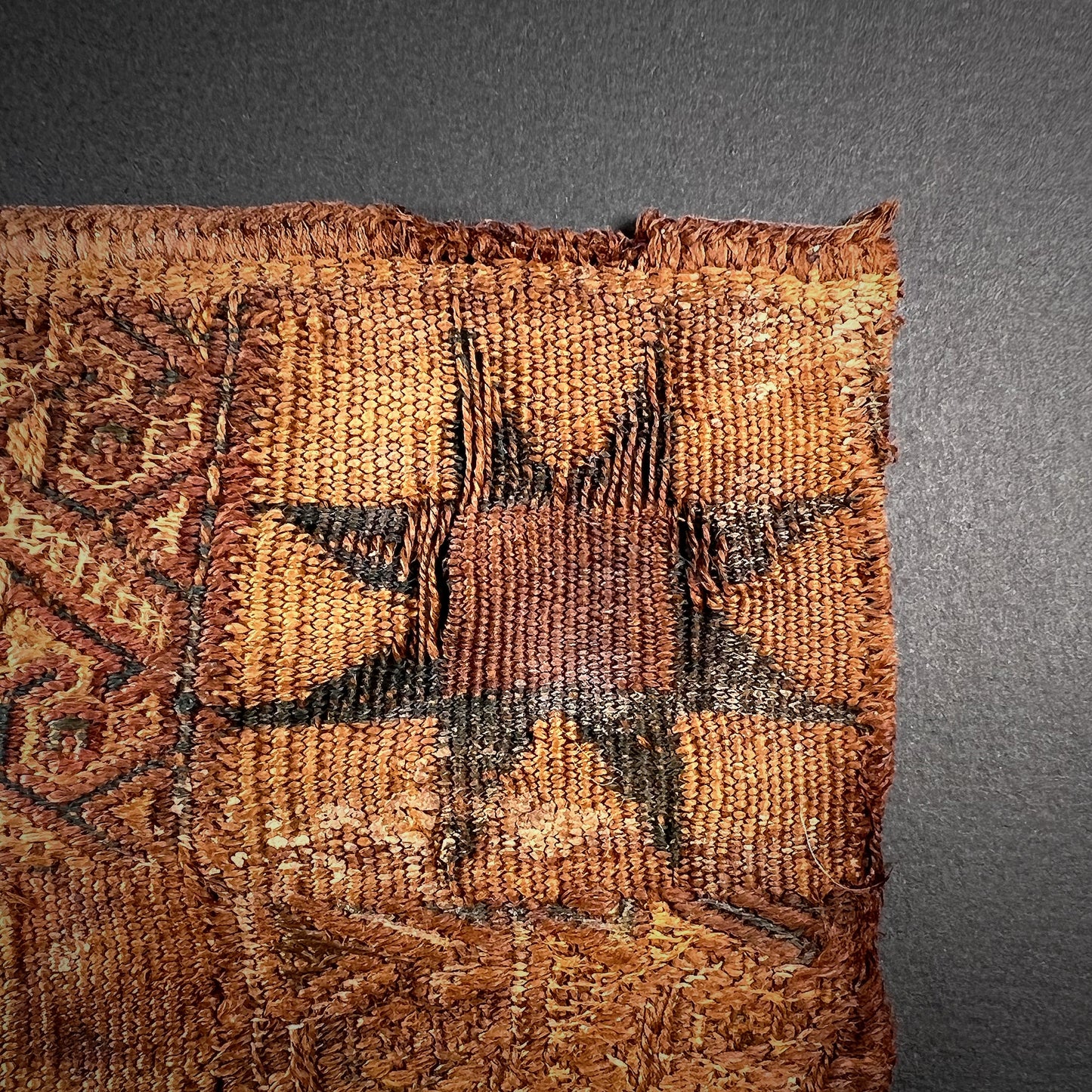
Inca Tunic Panel Fragment
Inca Tunic Panel Fragment
Couldn't load pickup availability
Pre-Columbian Era, Inca Empire, Late Horizon, c. 1400–1532 AD, possibly Ocoña or Majes, South Coast Valley, Peru
A mesmerizing rectangular fragment of finely woven Inca textile, decorated with a sophisticated sequence of eight-pointed stars, stylized birds, triangular motifs, and other conventional geometric devices arranged within square divisions and framed by rich red bands. The carefully ordered composition exemplifies the extraordinary technical mastery and aesthetic sophistication of Inca weaving traditions. The fragment would originally have formed part of a larger tunic (unku) or other high-status garment. Its geometric squares, commonly referred to as tocapus, represent one of the most distinctive features of elite Inca textiles and are thought to have functioned as a highly structured visual language conveying identity, status, affiliation, or other forms of social information.
The textile is woven from finely spun camelid fibres, most likely domestic alpaca wool, combined with cotton warps. It employs a sophisticated weft-faced interlocking tapestry weave, with finely woven Z-spun, S-ply wefts and carefully controlled warp structure. Heading cords remain visible at one end, providing an additional indication of the original construction of the textile. The dense and highly precise workmanship demonstrates the considerable skill required to produce such intricate geometric designs and is characteristic of the finest Andean weaving traditions.
The textile was likely produced using a traditional backstrap loom, a portable weaving technology capable of achieving extraordinary control over thread tension and pattern placement. The exceptionally fine construction and labour-intensive technique are suggestive of high-quality qompi or cumbi cloth, the finest category of Inca textiles. Such textiles were associated with royalty, nobility, religious ceremonies, and important state functions, and were among the most prestigious forms of material wealth within the Inca Empire.
The vibrant palette incorporates rich reds, creamy whites, warm ochres, moss greens, and deep indigo blues. These colours were produced from natural resources available throughout the Andes, including mineral pigments, native plants, and cochineal insects. The exceptionally arid climate of Peru's coastal valleys has preserved many ancient Andean textiles with remarkable clarity. This example remains particularly attractive, retaining strong colours, crisp geometric ornamentation, and clearly defined woven details.
Textiles occupied a central position within Inca society and were among the empire's most highly valued artistic and economic resources. Fine woven cloth could possess greater value than precious metals and served as a powerful expression of status, political authority, tribute, diplomacy, and religious devotion. Elite textiles such as this were therefore not merely garments but important instruments of imperial identity and social distinction. The highly regulated geometric compositions of the Late Horizon reflect both the extraordinary abilities of Inca weavers and the sophisticated organization of the expanding imperial state.
A visually striking and technically exceptional fragment, this Inca tunic panel offers a rare glimpse into the finest traditions of ancient Andean textile production. With its vivid colours, intricate tocapu-like designs, sophisticated tapestry construction, and surviving heading cords, it is a compelling and tangible connection to the artistic, social, and ceremonial world of the Inca Empire.
Good condition. Surface wear and abrasions commensurate with age and use. Loose threads. Size approx. 18,5cm x 11,7cm.
Provenance: Swedish private collection
For a similar examples see:
Panel from a tunic, University of Cambridge, Museum of Archaeology and Anthropology, Accession number:1935.325.1 (https://collections.maa.cam.ac.uk/objects/541146/?query=1935.325)
Frammento di tessuto cultura Inca, Museo delle Culture, Milano (MI) (https://www.lombardiabeniculturali.it/opere-arte/schede/6c040-01743/)


-
Shipping
The shipment will be prepared in the course of 3-5 days and dispatched via Posti Group Oyj or purchased item(s) can be picked up from our shop during the store's opening hours (Tarkk’ampujankatu 4, 00140, Helsinki, Finland). Within the Finland, all items are shipped via Posti Group Oyj unless otherwise requested. We pack the items carefully and mainly in recycled materials because we want to save nature. You will receive the tracking number for your items by e-mail.
-
Returns
Returns and exchange will be accepted within fourteen days (14) of receipt at the purchaser’s cost to include freight and packaging. Items must be returned in the same condition as when they were shipped, and will not be accepted if damaged or altered in any way. Please inform us via email (info@gotanmaailma.fi) or by calling +358408408352 before sending. We do not accept returns more than 14 days after delivery.