


Khartoum Culture Pottery Fragments
Khartoum Culture Pottery Fragments
Couldn't load pickup availability
Neolithic Period, c. 5000–2500 BC, Khartoum, Central Sudan
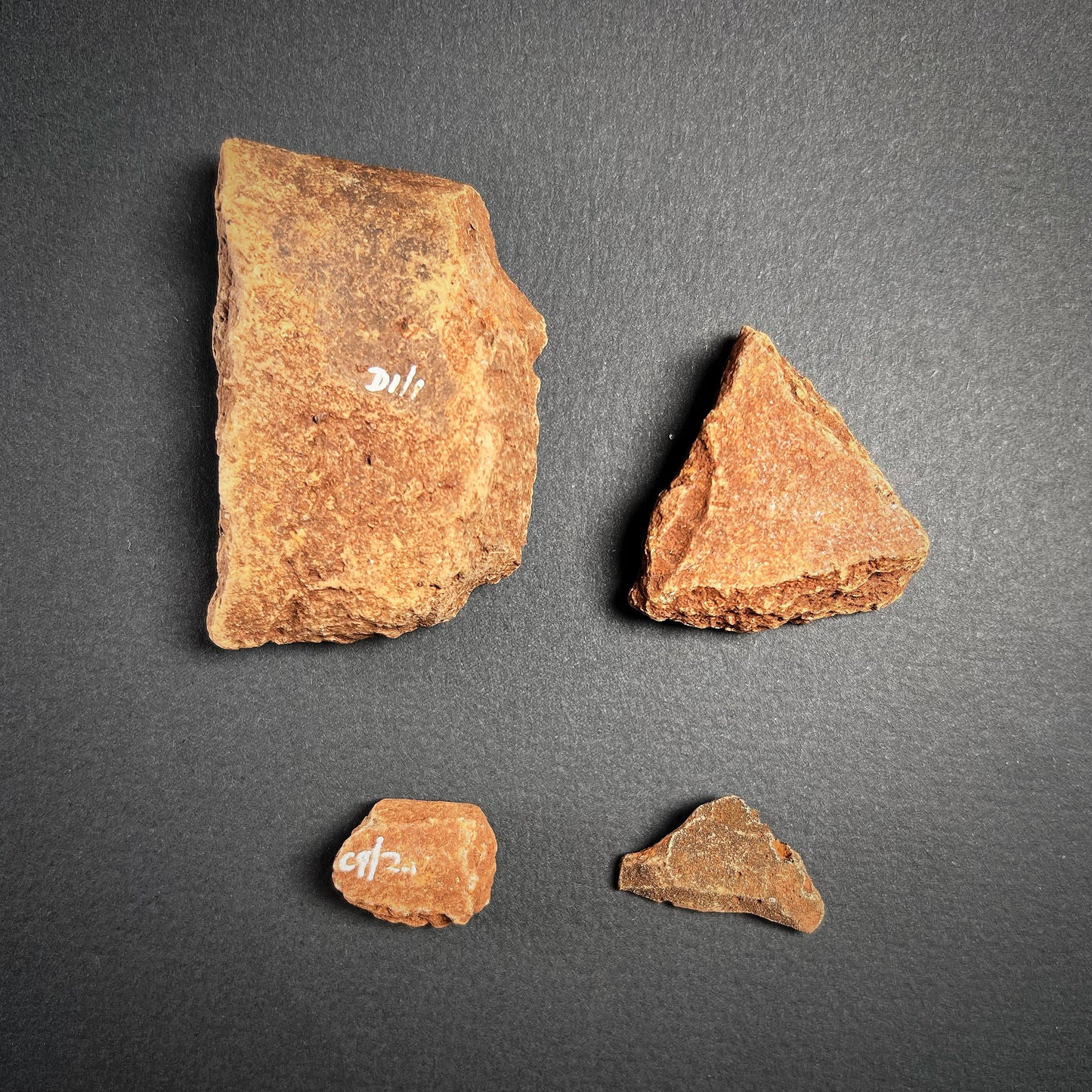
A beautiful and exceptionally well-preserved group of four pottery fragments from thick-walled, open-mouthed, globular vessels, crafted from coarse Nile clay tempered with sand, quartz, mica, and organic fibres during the Neolithic Period. The gently curved sherds retain attractive burnished surfaces and preserve a variety of decorative techniques characteristic of early pottery traditions in the central Sudan.
Neolithic pottery from the Khartoum region is particularly noted for its rich diversity of surface treatments and geometric ornament. Common decorative techniques included burnishing, horizontal linear incisions, dotted zigzag patterns, evenly or irregularly spaced dots, horizontal dotted lines created with alternating pivoting stamps, semi-circular concentric dotted lines, scraping, incised fish-scale patterns, and darkened or black-rimmed surfaces. Such decoration was not merely ornamental but formed an important part of the visual language of early Sudanese ceramic traditions.
A wide variety of tools could be employed to create these patterns, including combs, pronged implements, and spatulas fashioned from bone, mollusc shell, wood, plant material, or clay. Essentially any implement with a suitably serrated or shaped edge could be pressed, dragged, or impressed into the soft clay before firing. The largest fragment is especially striking, preserving an incised ripple-ware pattern produced by dragging a multi-toothed tool across the surface of the wet clay. This distinctive technique is well documented at important Neolithic sites such as Esh-Shaheinab and Kadero.
The coarse Nile clay and carefully applied surface decoration provide valuable evidence for the technological development of pottery production in prehistoric Sudan. Such vessels would have served practical domestic purposes, while their elaborate ornamentation demonstrates the growing importance of ceramic decoration within Neolithic communities.
The white ink annotations, including markings such as “C13/2” and “D1/1”, are consistent with archaeological registrar or collection markings used to identify and catalogue individual objects according to excavation area, trench or layer, and artifact group. These surviving annotations add an intriguing documentary dimension to the fragments, preserving a connection to their archaeological and collecting history.
An exceptionally attractive group of prehistoric ceramic fragments, these pieces offer a fascinating glimpse into the technological skill, decorative traditions, and daily life of Neolithic communities along the Nile more than 6,000 years ago.
Good condition. Fragment as shown. Size varies from 6,0cm to 1,5cm. Sell as a set.
Provenance: Swedish private collection. Acquired abroad and brought to Sweden in the 1960s.

-
Shipping
The shipment will be prepared in the course of 3-5 days and dispatched via Posti Group Oyj or purchased item(s) can be picked up from our shop during the store's opening hours (Tarkk’ampujankatu 4, 00140, Helsinki, Finland). Within the Finland, all items are shipped via Posti Group Oyj unless otherwise requested. We pack the items carefully and mainly in recycled materials because we want to save nature. You will receive the tracking number for your items by e-mail.
-
Returns
Returns and exchange will be accepted within fourteen days (14) of receipt at the purchaser’s cost to include freight and packaging. Items must be returned in the same condition as when they were shipped, and will not be accepted if damaged or altered in any way. Please inform us via email (info@gotanmaailma.fi) or by calling +358408408352 before sending. We do not accept returns more than 14 days after delivery.