

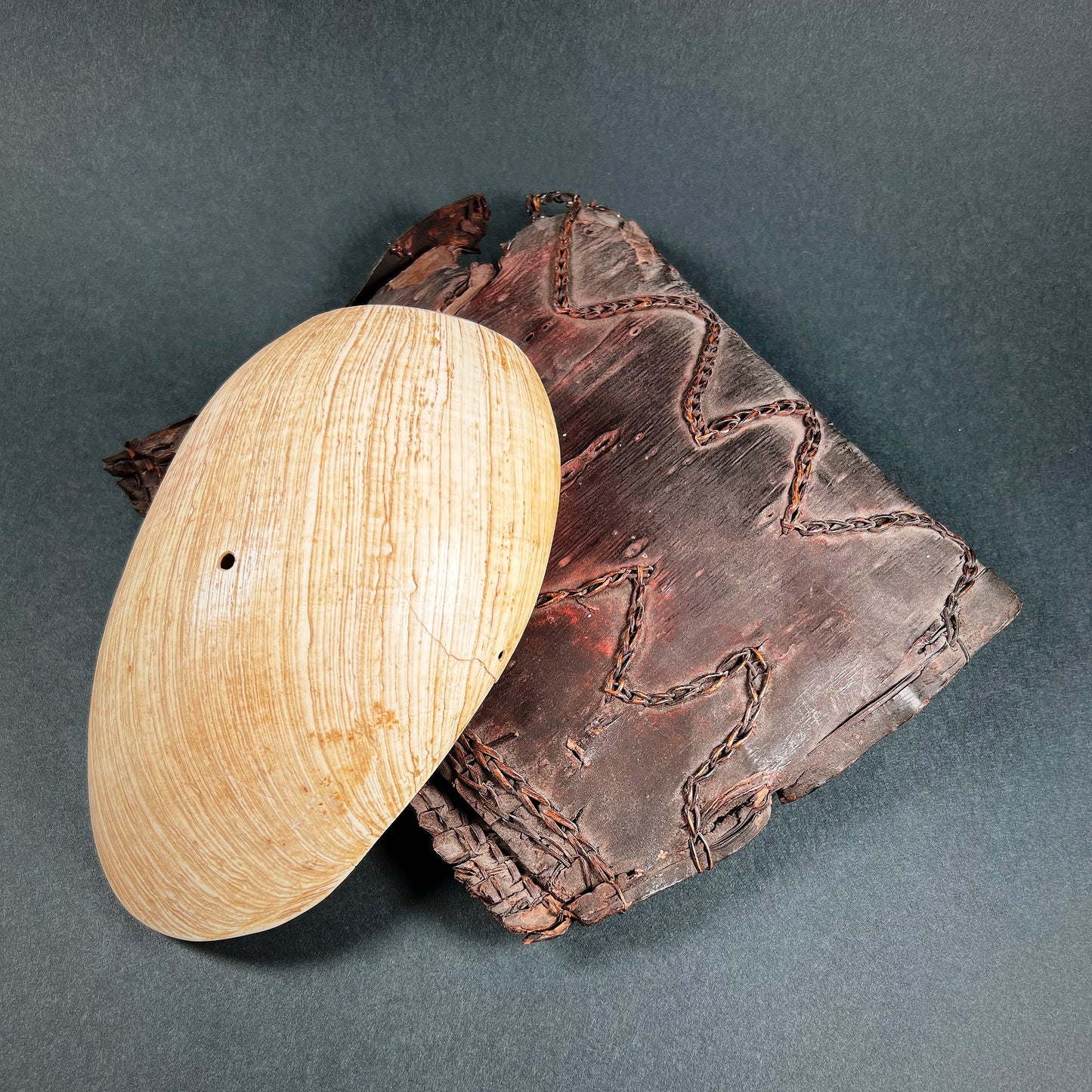
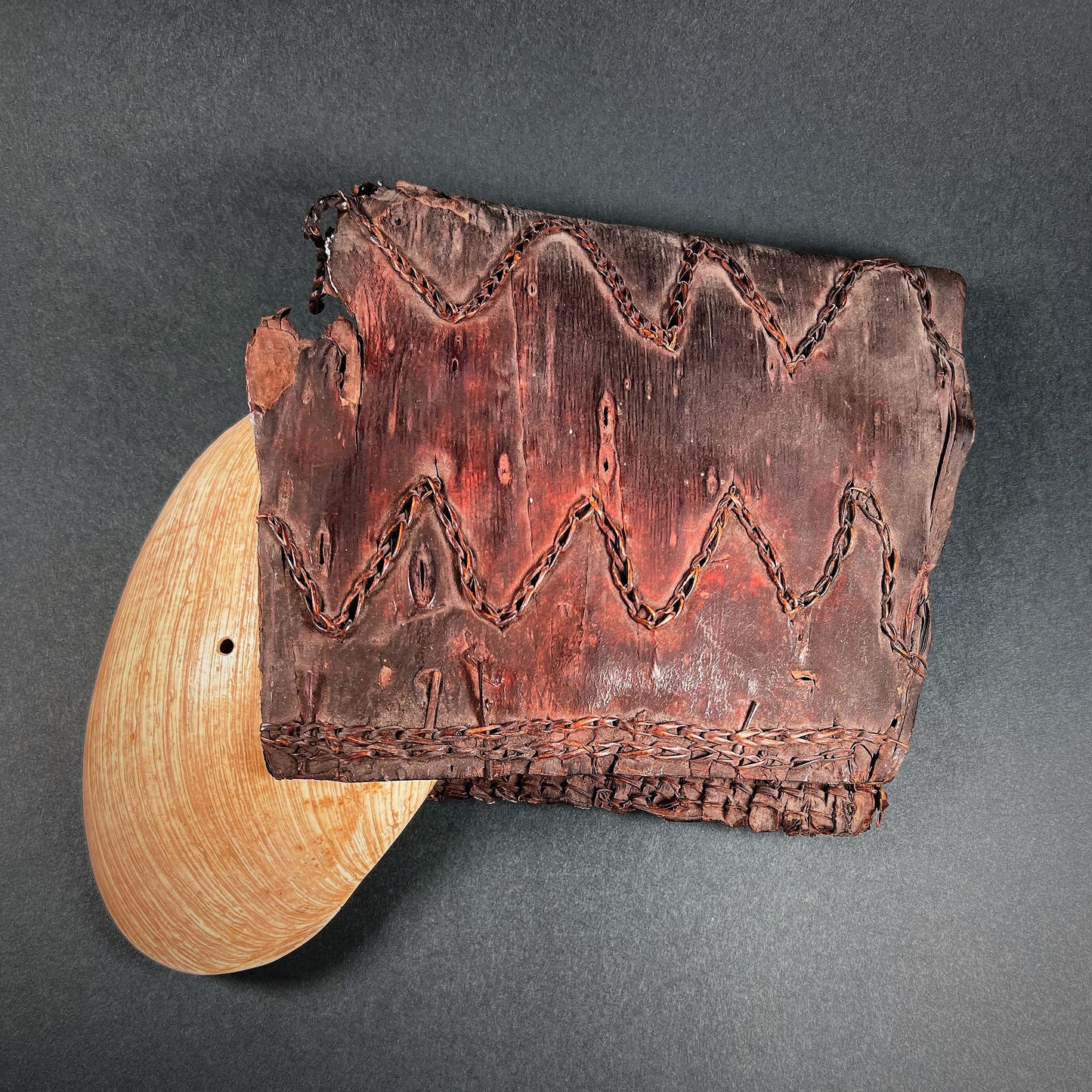
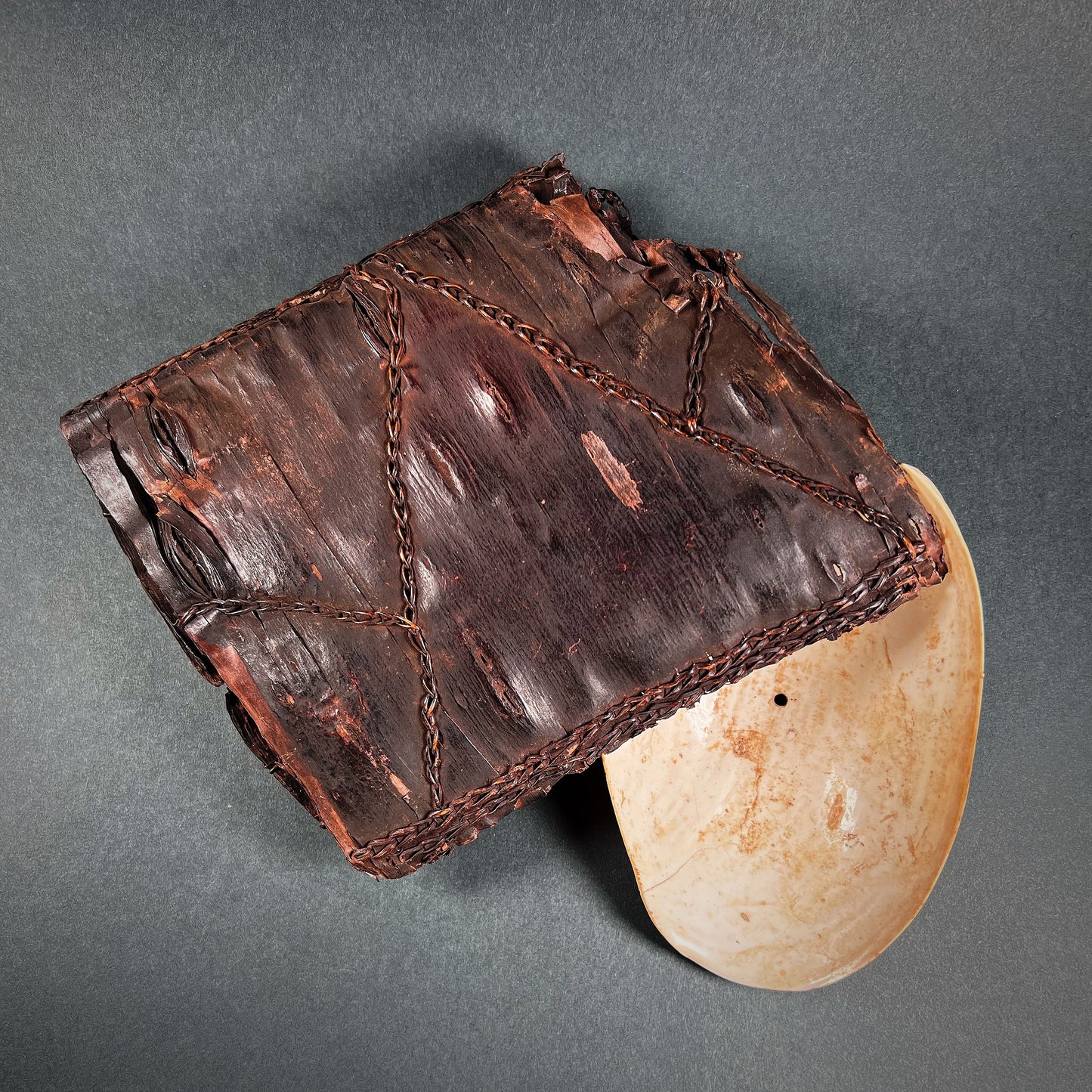
Mendi Bailer Shell Pectoral (Gam) with Bark Wallet
Mendi Bailer Shell Pectoral (Gam) with Bark Wallet
Couldn't load pickup availability
Mendi People, Early to Mid-20th Century, Mendi Valley, Southern Highlands Province, Papua New Guinea
A striking and beautifully aged Bailer Shell (Melo amphora) pectoral ornament, known as a gam, finely cut, polished, and pierced for suspension on a fibre cord. This impressive shell pendant is accompanied by its traditional bark wallet, decorated with expertly braided zig-zag motifs and retaining traces of red pigment—an elegant testament to long use and careful preservation.
Shell wealth has held immense cultural value throughout Papua New Guinea, but nowhere more so than in the Highlands. Bailer shells originated on distant coasts and were traded across hundreds of kilometres of rugged, mountainous terrain before reaching inland communities. Because the Highland peoples had no direct contact with the sea, these large marine shells were regarded as rare and extraordinary. As a result, shell ornaments became prized items of adornment worn during important ceremonies and served as a fundamental form of traditional wealth.
Among the Mendi, gam pectorals functioned not only as personal adornments but also as high-value currency. They featured prominently in bridewealth payments, compensation exchanges, settlement of land disputes, and funeral presentations honouring influential men and women. Their value lay equally in the shell’s rarity, its craftsmanship, and its social history as it passed from clan to clan.
The Mendi inhabit the narrow and fertile Mendi Valley in Papua New Guinea’s Southern Highlands. Traditional Mendi society, first contacted by Australian patrols in 1950, was composed of dispersed homesteads organised within patrilineal clan territories. Each clan area (su) centred around a communal open space (koma), used for meetings, rituals, and collective exchanges. Wealth items such as this shell pectoral were essential to maintaining social balance, strengthening kinship ties, and participating in the region’s intricate system of ceremonial exchange.
Good condition. Age-related wear and signs of use. Traces of red pigment. Chip and fractures. Size approx. 14,5cm x 9,8cm & 14,3cm x 17,5cm. Sell as a set.
Provenance: Finnish private collection
References and further reading:
Mende Culture and Tradition: a Recent Survey, Theodore Mawe, P.N.G. National Museum Record, no. 10. Boroko, Papua New Guinea: Institute of Papua New Guinea Studies, 1985.
-
Shipping
The shipment will be prepared in the course of 3-5 days and dispatched via Posti Group Oyj or purchased item(s) can be picked up from our shop during the store's opening hours (Tarkk’ampujankatu 4, 00140, Helsinki, Finland). Within the Finland, all items are shipped via Posti Group Oyj unless otherwise requested. We pack the items carefully and mainly in recycled materials because we want to save nature. You will receive the tracking number for your items by e-mail.
-
Returns
Returns and exchange will be accepted within fourteen days (14) of receipt at the purchaser’s cost to include freight and packaging. Items must be returned in the same condition as when they were shipped, and will not be accepted if damaged or altered in any way. Please inform us via email (info@gotanmaailma.fi) or by calling +358408408352 before sending. We do not accept returns more than 14 days after delivery.