


Ming Dynasty Pottery Miniature Vases
Ming Dynasty Pottery Miniature Vases
Couldn't load pickup availability
Ming Dynasty, c. 1550–1644, China
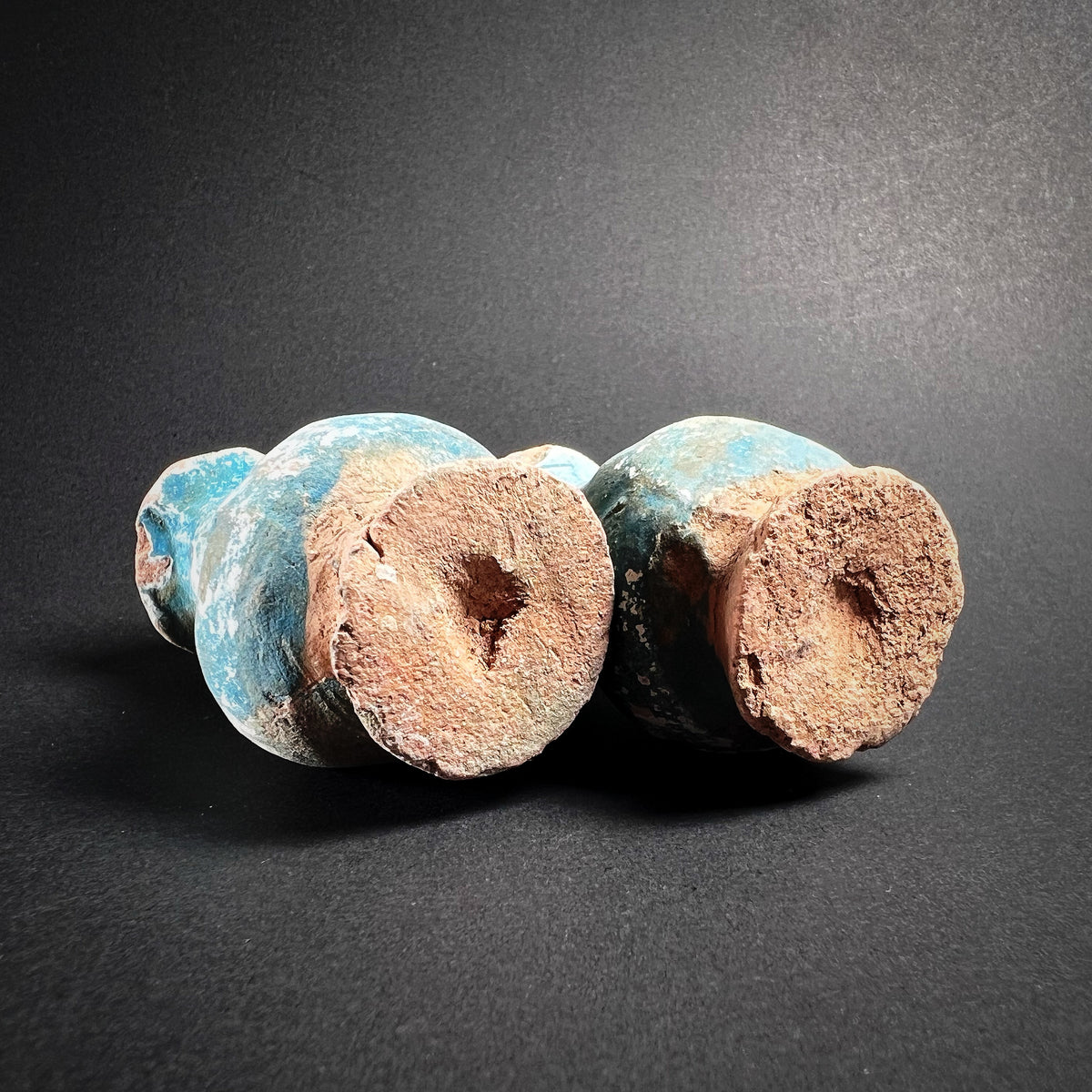
An absolutely charming pair of miniature baluster-form vases in the Han Dynasty style, distinguished by their heavily weathered surfaces and appealingly crude, rustic character. Each vase features a broad, out-turned and slightly asymmetrical rim, narrowing into a slender, constricted neck before expanding into a rounded, pear-shaped body. The vessels rest on thick, unevenly trimmed foot rings, adding further character to their deliberately modest and utilitarian appearance.
The vases were originally covered with a turquoise-green lead glaze over a warm reddish-brown terracotta clay body. Much of the original glaze has now disappeared, while the surviving traces have undergone extensive alteration through burial. The former turquoise-green surface has largely transformed into a dry, chalky-white and powdery layer composed of soil minerals and lead corrosion products, creating an evocative archaeological appearance and providing visible evidence of their long interment.Objects of this type were produced as funerary goods and placed within tombs alongside the deceased. Their inclusion reflected the belief that the dead would continue to require familiar objects and material comforts in the afterlife. Miniature vessels such as these therefore served as symbolic substitutes for the larger objects used during earthly life.
The Ming dynasty witnessed some of the greatest artistic and cultural achievements in Chinese history, supported in part by the considerable economic prosperity of the period. The tradition of placing miniature terracotta objects within tombs, however, was considerably older, extending back to the Han dynasty and earlier. These objects are generally known as mingqi, meaning “spirit utensils” or “vessels for ghosts”, and were intended to accompany and assist the deceased in the next world.
Mingqi could take an extraordinary variety of forms, including cooking vessels, houses and temples, furniture, incense burners, servants, animals, and other objects associated with daily life. Both anthropomorphic and zoomorphic figures were particularly popular, serving to recreate the familiar world of the living and provide companionship and symbolic assistance to the deceased.
With their distinctive weathered surfaces, traces of transformed turquoise-green glaze, and attractive archaizing Han-style forms, this pair of miniature vases offers a fascinating glimpse into the funerary traditions of Ming dynasty China. Rustic yet highly evocative, they embody the enduring Chinese belief that aspects of earthly life could continue beyond death, making them particularly appealing examples of mingqi and ancient Chinese burial art.
Good condition. Heavy surface wear and abrasions commensurate with age, nicks and chip, with fading to some finer features, and light encrustations within recessed areas. Nice earthen deposits throughout. Glazing defects and firing flaws. Size approx. 6,6cm x 3,6cm x 3,8cm. Sell as a pair.
Provenance: British private collection
References and further reading:
The Matter of Tang Tomb Figures; A New Perspective on a Group of Terracotta Animals and Riders, Lucien Van Valen & Isabelle Garachon, The Rijksmuseum Bulletin, Volume 62. pp. 218-239, 2014.
Dream of Ideal Life in Ancient China: Ceramic Miniatures of Architectures, Household Goods, People and Animals, Aichi.ken Toji Shiryokan, Seto, 2005, no. 14, p. 34.
Antecedents of Sui-Tang Burial Practices in Shaanxi, Mary Fong, Artibus Asiae 51, no:s. 3–4 (1991), pp. 147–98.
Mingqi - Items for the next world, Jan-Erik Nilsson, Gotheborg.com (https://gotheborg.com/glossary/mingqi.shtml)
Immortality of the Spirit: Chinese Funerary Art from the Han and Tang Dynasties Exhibition Catalogue, Jill J. Deupi, Ive Covaci & Leopold Swergold, Immortality of the Spirit - Ephemera. 1, Fairfield University, 2012. (https://digitalcommons.fairfield.edu/immortality_ephemera/1)
The Vibrant Role of Mingqi in Early Chinese Burials, Heilbrunn Timeline of Art History, Heather Colburn Clydesdale, Independent Scholar, The Metropolitan Museum of Art, April 2009. (www.metmuseum.org/toah/hd/mgqi/hd_mgqi.htm)


-
Shipping
The shipment will be prepared in the course of 3-5 days and dispatched via Posti Group Oyj or purchased item(s) can be picked up from our shop during the store's opening hours (Tarkk’ampujankatu 4, 00140, Helsinki, Finland). Within the Finland, all items are shipped via Posti Group Oyj unless otherwise requested. We pack the items carefully and mainly in recycled materials because we want to save nature. You will receive the tracking number for your items by e-mail.
-
Returns
Returns and exchange will be accepted within fourteen days (14) of receipt at the purchaser’s cost to include freight and packaging. Items must be returned in the same condition as when they were shipped, and will not be accepted if damaged or altered in any way. Please inform us via email (info@gotanmaailma.fi) or by calling +358408408352 before sending. We do not accept returns more than 14 days after delivery.