


Neolithic Capsian Culture Quartz Amulet Bead
Neolithic Capsian Culture Quartz Amulet Bead
Couldn't load pickup availability
Capsian Culture, c. 8000–3000 BC, Northwest Sahara, North Africa
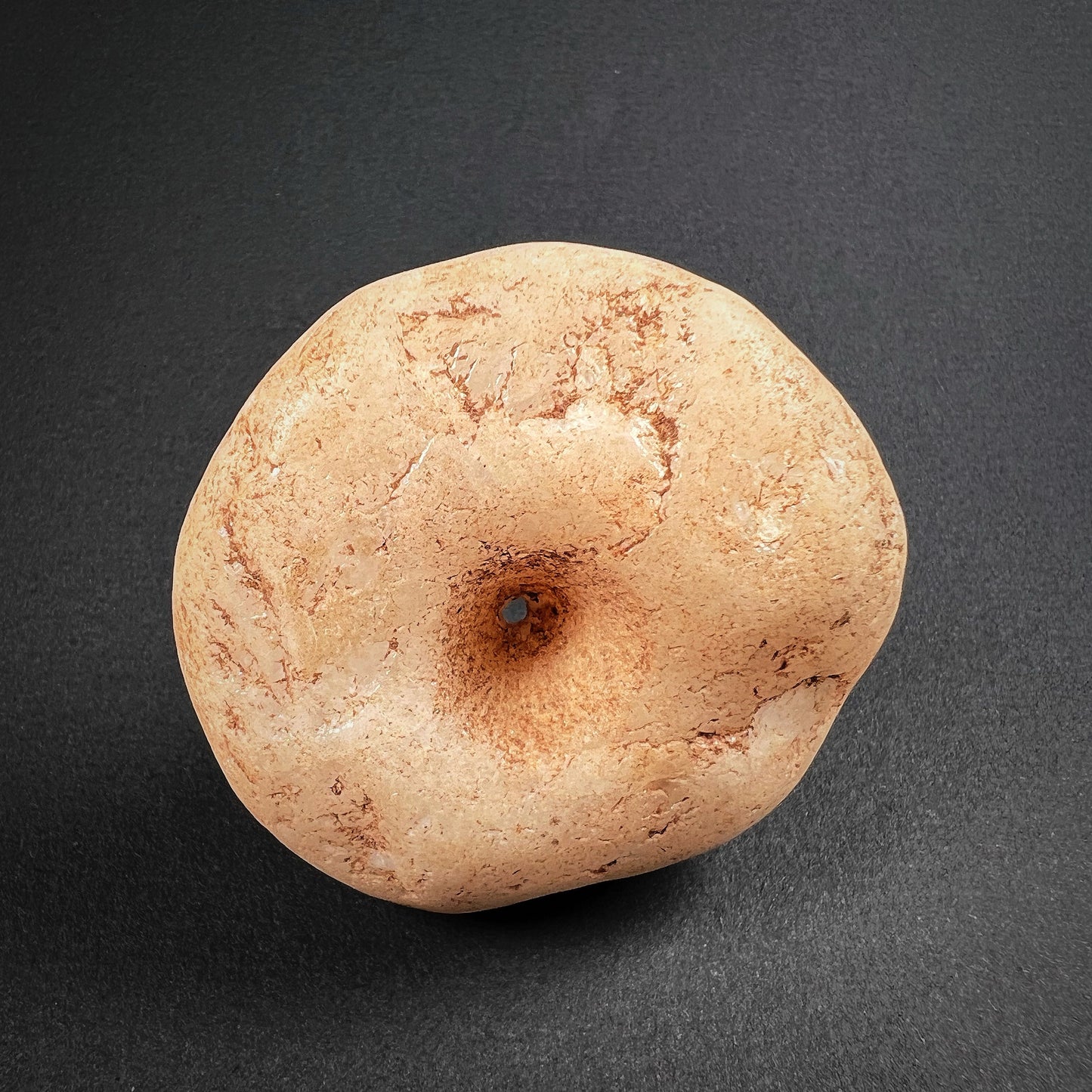
A superb and exceptionally well-crafted Neolithic discoidal amulet bead, expertly carved from opaque white milky quartz and carefully perforated for suspension. Quartz is an exceptionally hard stone to shape and drill using prehistoric technology, making the production of such an object a considerable technical achievement. Finely polished across its surfaces, this complete bead demonstrates a remarkable level of craftsmanship, requiring far greater time, patience, and skill than the manufacture of contemporary flaked stone tools. It was almost certainly worn as a pendant, suspended from a cord around the neck, serving as both a personal ornament and a symbolic amulet.
The quality of workmanship displayed by this example reflects the growing technological sophistication of Neolithic communities inhabiting the ancient Sahara, where lapidary skills developed alongside increasingly complex social and ritual traditions.
The Capsian culture, one of the principal Mesolithic and Neolithic traditions of North Africa, flourished across the eastern Maghreb—particularly present-day eastern Algeria and west-central Tunisia—between approximately 8000 and 2700 BC. First identified in 1909 at the site of El-Mekta near the ancient city of Capsa (modern Gafsa), the culture developed during the African Humid Period, when much of the Sahara consisted of open grasslands, lakes, and savanna environments inhabited by abundant wildlife, in striking contrast to the desert landscape of today.
Capsian communities subsisted primarily through hunting, gathering, and the large-scale collection of edible land snails, an activity so characteristic that extensive shell middens, known as escargotières, remain among their most distinctive archaeological signatures. Faunal remains recovered from Capsian sites include aurochs, gazelles, hartebeest, hares, and numerous other species that once roamed the fertile Saharan landscape. Their carefully furnished burials, often accompanied by ornaments such as beads and pendants, point to increasingly elaborate ritual practices and a belief in an afterlife.
Objects of personal adornment such as this quartz bead were among the earliest expressions of identity, status, and symbolic belief in prehistoric North Africa. More than simple ornaments, they likely served as protective amulets or markers of social affiliation, embodying both aesthetic appreciation and spiritual significance.
A beautifully preserved and historically important artifact, this finely worked quartz amulet bead offers a tangible connection to the lives, beliefs, and remarkable craftsmanship of the Neolithic peoples who inhabited the once-green Sahara thousands of years ago.
Good condition. Wear consistent with age and use. Intact without repairs. Minor nicks and chips to peripheries. Nice mineral deposits and iron hued patina in flaked areas. Size approx. 5,3cm x 5,2cm x 2,1cm.
Provenance: Dutch private collection.
References and further reading:
Late Pleistocene-Early Holocene Maghreb. In Peregrine, Peter Neal; Ember, Melvin (eds.). Encyclopedia of Prehistory, Vol. 1 : Africa. New York: Kluwer Academic/ Plenum Publishers, 2001, pp. 129–149. (https://watarts.uwaterloo.ca/~dlubell/Ency_Maghreb.pdf)
Technological and Cultural Change Among the Last Hunter-Gatherers of the Maghreb: The Capsian (10,000–6000 B.P.), Noura Rahmani, Journal of World Prehistory 18, no. 1 (2004): 57–105. (http://www.jstor.org/stable/25801215)
Paleoenvironments and Epi Paleolithic economies in the Maghreb (ca. 20,000 to 5000 B.C.), David Lubell, In, J.D. Clark & S.A. Brandt (eds.), From Hunters to Farmers: The Causes and Consequences of Food Production in Africa, Berkeley: University of California Press, 1984 pp. 41–56.(https://watarts.uwaterloo.ca/~dlubell/Lubell_1984.pdf)

-
Shipping
The shipment will be prepared in the course of 3-5 days and dispatched via Posti Group Oyj or purchased item(s) can be picked up from our shop during the store's opening hours (Tarkk’ampujankatu 4, 00140, Helsinki, Finland). Within the Finland, all items are shipped via Posti Group Oyj unless otherwise requested. We pack the items carefully and mainly in recycled materials because we want to save nature. You will receive the tracking number for your items by e-mail.
-
Returns
Returns and exchange will be accepted within fourteen days (14) of receipt at the purchaser’s cost to include freight and packaging. Items must be returned in the same condition as when they were shipped, and will not be accepted if damaged or altered in any way. Please inform us via email (info@gotanmaailma.fi) or by calling +358408408352 before sending. We do not accept returns more than 14 days after delivery.