


Neolithic Thai Nephrite Jade Bangle
Neolithic Thai Nephrite Jade Bangle
Couldn't load pickup availability
Ban Chiang or Ban Non Wat Culture, Neolithic period, c. 2200 BC – 200 BC, Northeastern Thailand, Southeast Asia
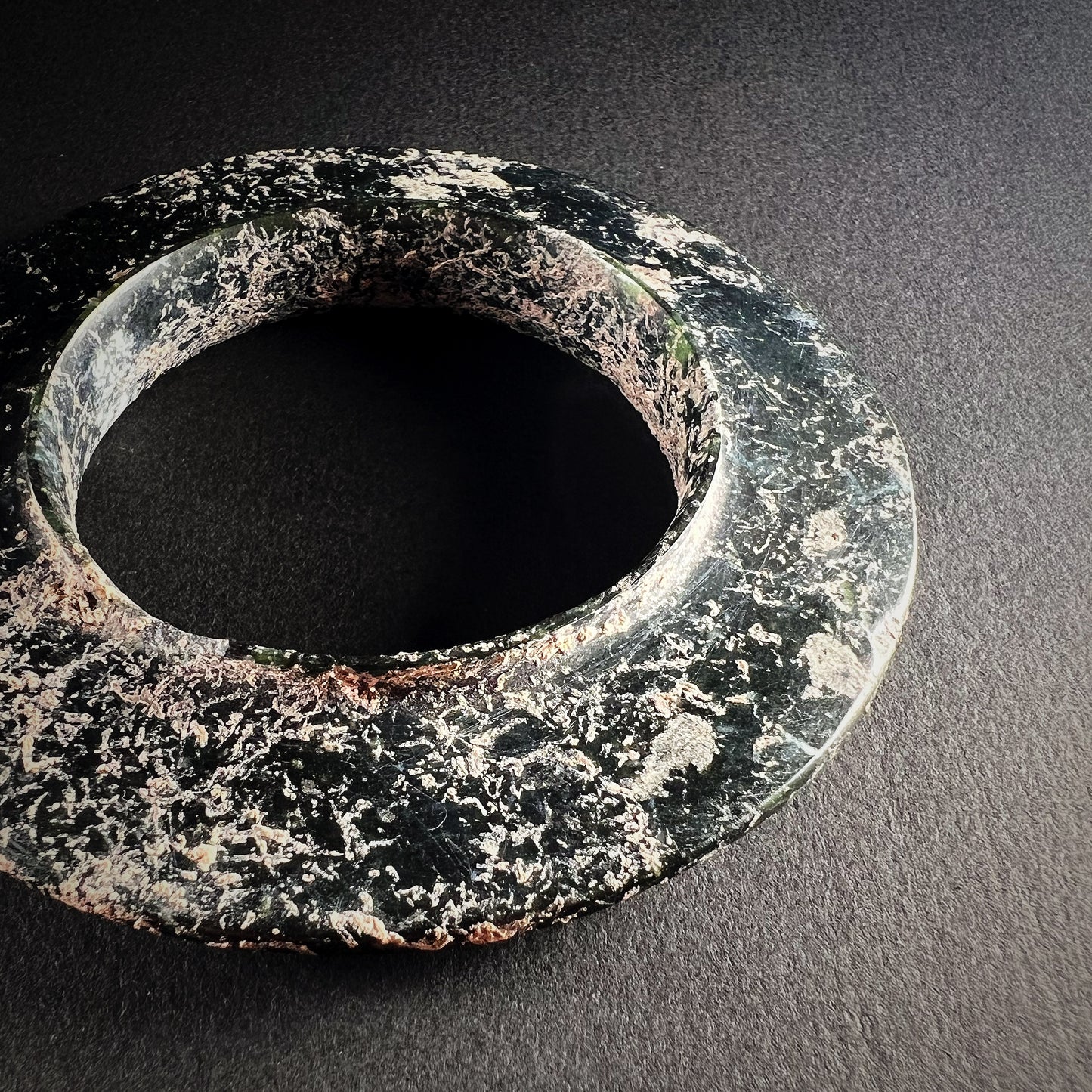
An absolutely charming and exceptionally rare deep green stone bangle, most likely fashioned from nephrite jade, distinguished by its elegant taper toward the outer rim and a raised collar encircling the central perforation. The stone displays a richly variegated dark green coloration, lending the piece both visual depth and material prestige. The form is carefully proportioned and technically refined, reflecting the advanced lapidary skills achieved by Neolithic communities in Southeast Asia.
The precise function of such bangles remains a subject of scholarly debate. Stone bracelets of this type are known across a wide range of Asian cultures and demonstrate a high degree of symbolic abstraction during the Neolithic period (4th–1st millennium BC). Archaeological and comparative evidence suggests that these objects carried ritual significance while also serving as personal adornments and, at times, as items of exchange or markers of social status.
Although many examples preserved in museum collections lack secure archaeological provenance, a sufficient number have been recovered from controlled excavations in China, Vietnam, Thailand, and Malaysia to confirm their cultural importance. These bangles were clearly highly valued objects, frequently placed on the arms of the deceased in burial contexts and almost certainly worn during ceremonial or ritual occasions in life.
Hardstone bracelets with drilled centres were already being produced in North and Central China during the Late Neolithic period (c. 3500–2500 BC). It is widely accepted that the associated technologies and stylistic traditions gradually spread southward with the expansion of Austro-Asiatic–speaking populations, reaching Southeast Asia by the late third millennium BC. Numerous production sites for stone bracelets have been identified in Thailand, Hong Kong, and Vietnam. Among the most thoroughly documented is the late second-millennium BC jade bracelet workshop at Trang Kenh, near Hai Phong in northern Vietnam (Nguyen Kim Dung, forthcoming). Excavations at this site demonstrate that bracelet centres were drilled from both sides using rotating jigs and jasper gouges, before the central core was carefully removed.
This rare green stone bangle stands as a compelling testament to Neolithic technological sophistication, long-distance cultural transmission, and the ritual and social importance of personal ornamentation in early Southeast Asian societies.
Good condition. Surface wear and abrasions commensurate with age, nicks and chip. Encrusted earthen deposits throughout with multiple rootmarks. Size approx. 8,8cm x 8,8cm x 1,2cm
Provenance: Swedish private collection
For a similar examples see:
Disc bracelet, Sainsbury Centre, Accession Number: 1032 (https://sainsburycentre.ac.uk/art-and-objects/1032-disc-bracelet/)
References and further reading:
Early Thailand - From Prehistory to Sukhothai, Charles Higham & Rachanee Thosarat, River Books, 2012


-
Shipping
The shipment will be prepared in the course of 3-5 days and dispatched via Posti Group Oyj or purchased item(s) can be picked up from our shop during the store's opening hours (Tarkk’ampujankatu 4, 00140, Helsinki, Finland). Within the Finland, all items are shipped via Posti Group Oyj unless otherwise requested. We pack the items carefully and mainly in recycled materials because we want to save nature. You will receive the tracking number for your items by e-mail.
-
Returns
Returns and exchange will be accepted within fourteen days (14) of receipt at the purchaser’s cost to include freight and packaging. Items must be returned in the same condition as when they were shipped, and will not be accepted if damaged or altered in any way. Please inform us via email (info@gotanmaailma.fi) or by calling +358408408352 before sending. We do not accept returns more than 14 days after delivery.