


Roman Bone Plaque with Nude Venus
Roman Bone Plaque with Nude Venus
Couldn't load pickup availability
Late Roman Empire, c. 100–300 AD, Egypt
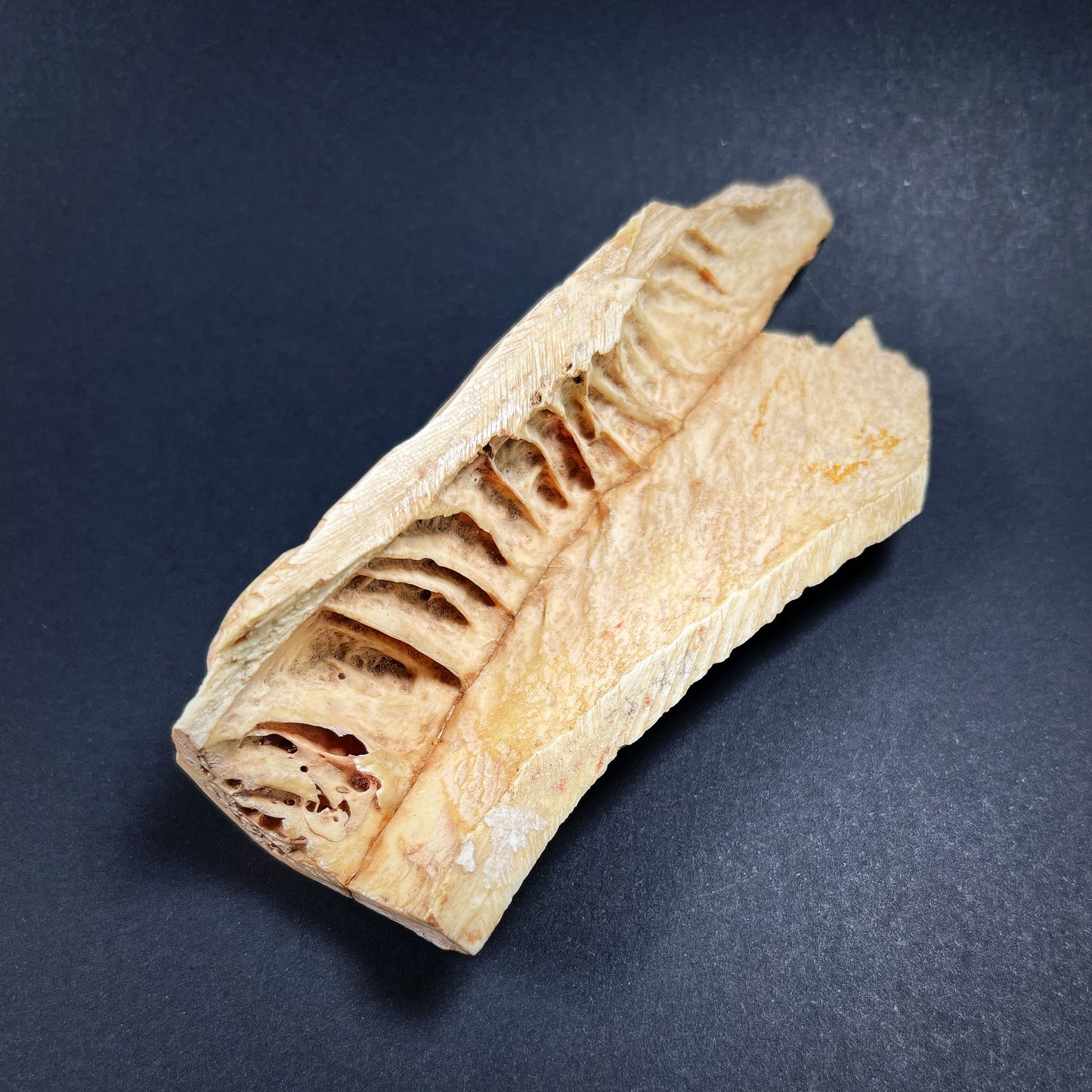
An exceptional and rare fragmentary rectangular plaque carved from eliphus (deer or stag bone), depicting a finely rendered nude female figure, possibly Aphrodite Anadyomene or Venus, executed in high relief. Dating to the Roman period, c. 100–300 AD, Egypt, the plaque reflects the enduring influence of classical Hellenistic artistic traditions within the cosmopolitan artistic environment of Roman Egypt.
The elegantly posed goddess stands before flowing, billowing drapery, turning her head gracefully to the left. Her lowered right hand gathers a fold of drapery, while her raised left arm gestures toward a mantle or cornucopia resting upon her shoulder. The figure is portrayed with flowing hair, soft modeling, and a relaxed naturalistic stance characteristic of classical depictions of Venus, embodying ideals of beauty inherited from the Greek artistic tradition.
Although the lower section of the plaque is now missing, the surviving portion remains remarkably refined. The piece was broken longitudinally in antiquity and has been carefully rejoined. The surface retains a fine polish, and the edges are smoothly finished, indicating that it originally served not as part of a vessel, but rather as a decorative applique or ornamental fitting, possibly attached to a luxurious piece of furniture, casket, or architectural furnishing.
The figure follows the classical Greco-Roman artistic canon, which increasingly supplanted ancient Egyptian stylistic conventions during the Ptolemaic and Roman periods. The plaque likely originates from Antinoopolis, the city founded by Emperor Hadrian in Middle Egypt at the site where his beloved Antinous drowned in AD 130. Renowned as a center of Hellenistic culture in Egypt, Antinoopolis flourished during the Roman and later Byzantine periods, becoming an important hub of artistic and material production.
This remarkable artifact beautifully illustrates the blending of classical Greek aesthetics with the cultural traditions of Roman Egypt during a transformative period in Late Antiquity, preserving the refined elegance and sensuality of ancient Mediterranean art.
Good condition. Surface wear and abrasions commensurate with age, nicks and chip, with polished patina. Size approx. 12,9cm x 5,3cm x 2,5cm.
Provenance: Dutch private collection.
For a similar examples see:
Bone plaque with Female Dancer, The Metropolitan Museum of Art, Accession Number: 2018.913.4 (https://www.metmuseum.org/art/collection/search/812958)
Carved bone plaque, Manchester Museum, Accession Number: 5422 (https://museu.ms/collection/object/37375?pUnitId=1374&pDashed=carved-bone-plaque)


-
Shipping
The shipment will be prepared in the course of 3-5 days and dispatched via Posti Group Oyj or purchased item(s) can be picked up from our shop during the store's opening hours (Tarkk’ampujankatu 4, 00140, Helsinki, Finland). Within the Finland, all items are shipped via Posti Group Oyj unless otherwise requested. We pack the items carefully and mainly in recycled materials because we want to save nature. You will receive the tracking number for your items by e-mail.
-
Returns
Returns and exchange will be accepted within fourteen days (14) of receipt at the purchaser’s cost to include freight and packaging. Items must be returned in the same condition as when they were shipped, and will not be accepted if damaged or altered in any way. Please inform us via email (info@gotanmaailma.fi) or by calling +358408408352 before sending. We do not accept returns more than 14 days after delivery.