


Roman Bronze Nail
Roman Bronze Nail
Couldn't load pickup availability
The Roman Empire, c. 100–300 AD
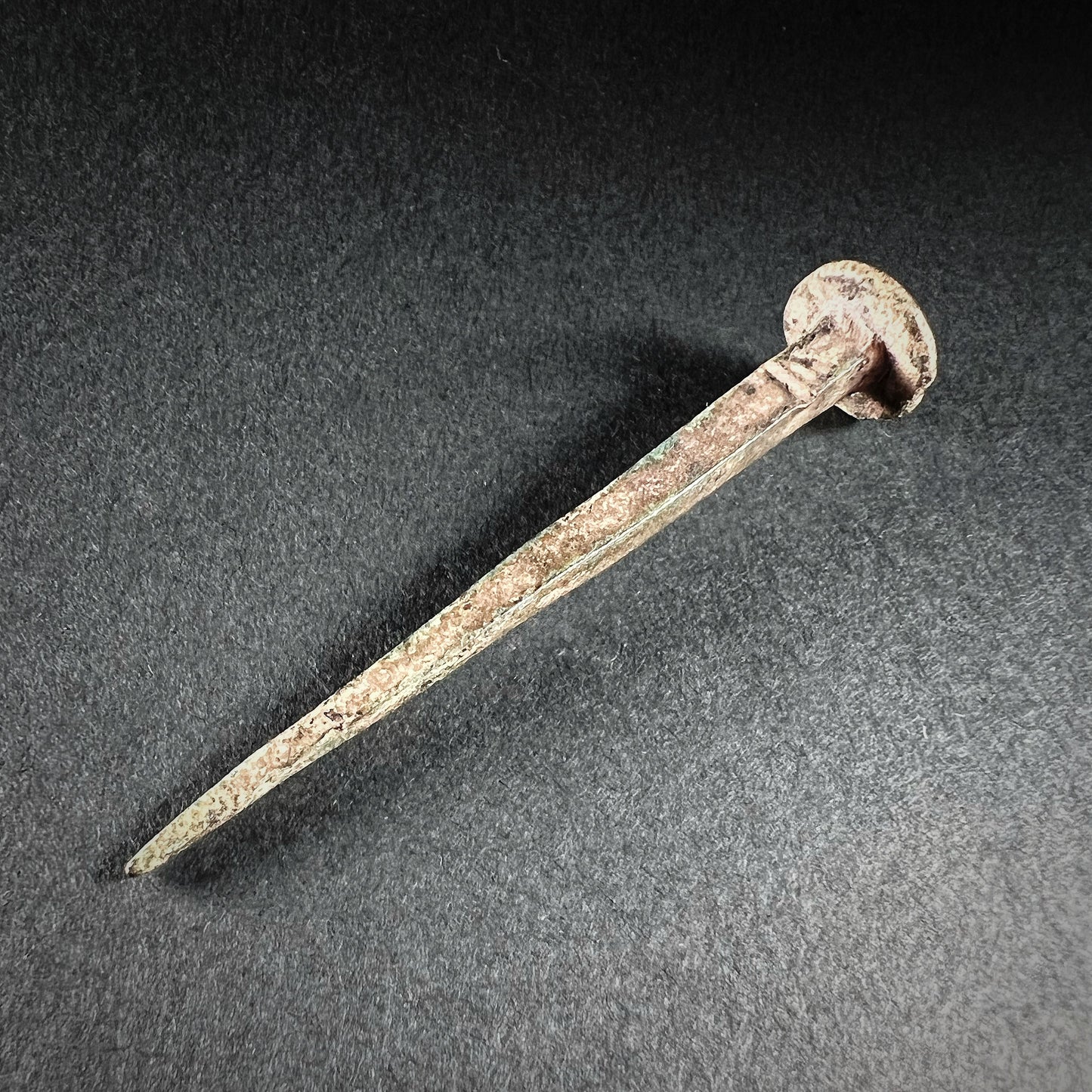
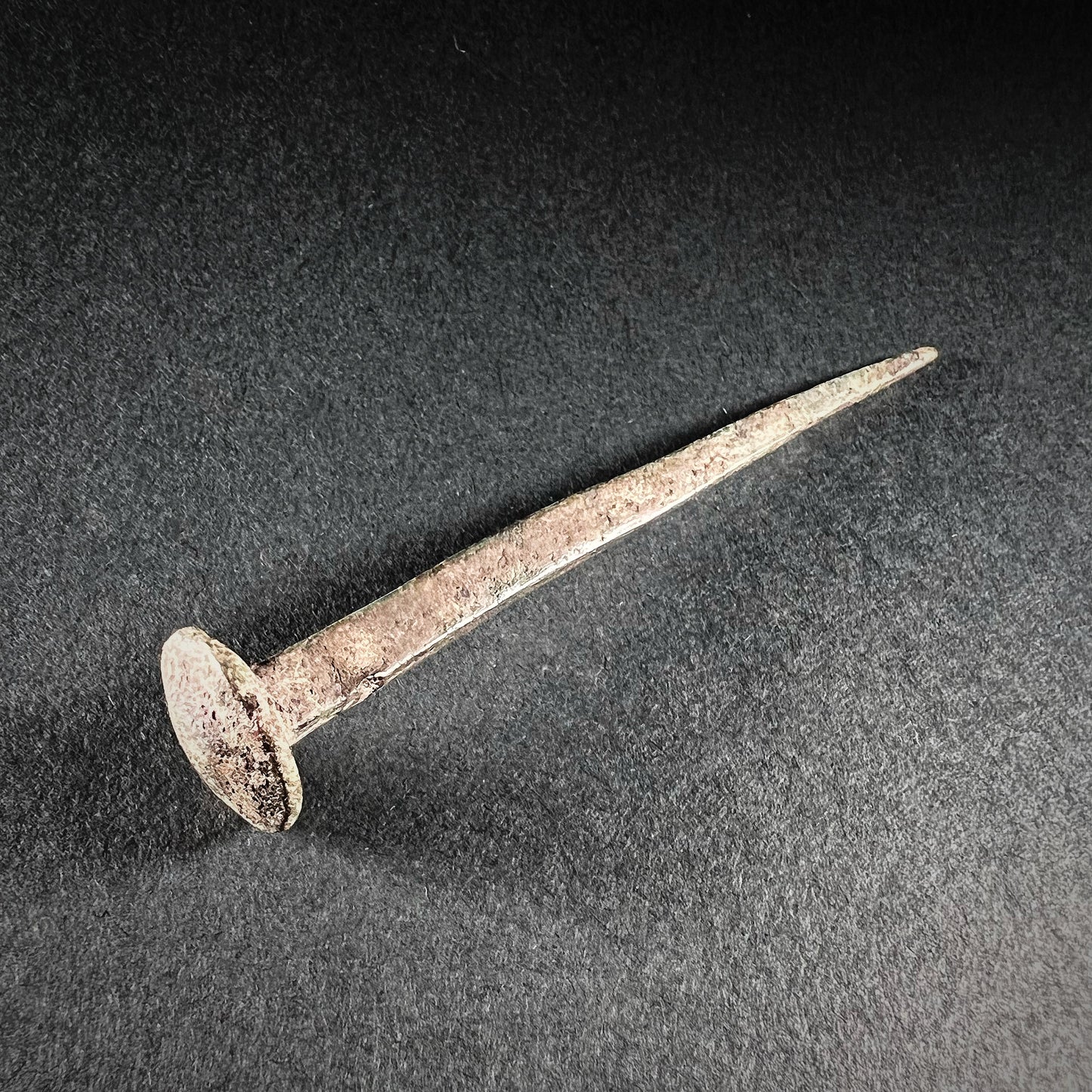
Excellent Roman bronze nail, cast with a conical head and a narrow four-faceted shank tapering to a sharp point. Forged by legionary metalworkers (fabrica), nails of this type were produced in vast quantities for military construction—used to secure timber fortifications, roofing, and structural elements throughout the Empire. A rich, mottled green patina now envelops its surface, adding to its ancient character.
Beyond their practical role, nails also held ritual and symbolic meaning in Roman culture. They were sometimes inscribed with protective incantations, fixed to doors or shrines as magical safeguards, or used in ceremonies such as the clavus annalis. Nails retrieved from tombs or sites of crucifixion were even worn as talismans against fever, misfortune, and malevolent forces. This fine example thus embodies both the utilitarian craftsmanship of the Roman military and the deeper magico-religious traditions of the ancient world.
Excellent condition. Surface wear and abrasions commensurate with age and use. A fine green patina envelops in layers of mottled grayish hues. Mineral encrustation and minimal corrosion. Size approx. 7,6cm x 1,4cm x 0,5cm.
Provenance: Danish private collection.
For a similar examples see:
Copper alloy nail, Ashmolean Museum, University of Oxford, Accession Number: AN1871.111 (https://collections.ashmolean.org/object/587615)
Nail, The Metropolitan Museum of Art, Accession Number: 74.51.5364 (https://www.metmuseum.org/art/collection/search/244243)
Nail, The British Museum, Accession Number: 1975,0723.11 (https://www.britishmuseum.org/collection/object/G_1975-0723-11)
References and further reading:
Mystifying Roman Nails: Clavus Annalis, Defixiones and Minkisi, David Dungworth, Theoretical Roman Archaeology Journal, 1997, pp: 148–159 (doi: https://doi.org/10.16995/TRAC1997_148_159)
Magical practices? A non-normative Roman imperial cremation at Sagalassos, J. Claeys, K. Van de Vijver, E. Marinova, S. Cleymans, P. Degryse & J. Poblome, Antiquity, 2023; 97(391): 158-175. (doi:10.15184/aqy.2022.171)
In a Roman Tomb, ‘Dead Nails’ Reveal an Occult Practice, Franz Lidz, The New York Times, Science, March 25, 2023. (https://www.nytimes.com/2023/03/25/science/archaeology-ancient-rome-tomb.html)
-
Shipping
The shipment will be prepared in the course of 3-5 days and dispatched via Posti Group Oyj or purchased item(s) can be picked up from our shop during the store's opening hours (Tarkk’ampujankatu 4, 00140, Helsinki, Finland). Within the Finland, all items are shipped via Posti Group Oyj unless otherwise requested. We pack the items carefully and mainly in recycled materials because we want to save nature. You will receive the tracking number for your items by e-mail.
-
Returns
Returns and exchange will be accepted within fourteen days (14) of receipt at the purchaser’s cost to include freight and packaging. Items must be returned in the same condition as when they were shipped, and will not be accepted if damaged or altered in any way. Please inform us via email (info@gotanmaailma.fi) or by calling +358408408352 before sending. We do not accept returns more than 14 days after delivery.