


Roman Glass Lentoid Flask
Roman Glass Lentoid Flask
Couldn't load pickup availability
Late Roman Empire, c. 100–300 AD
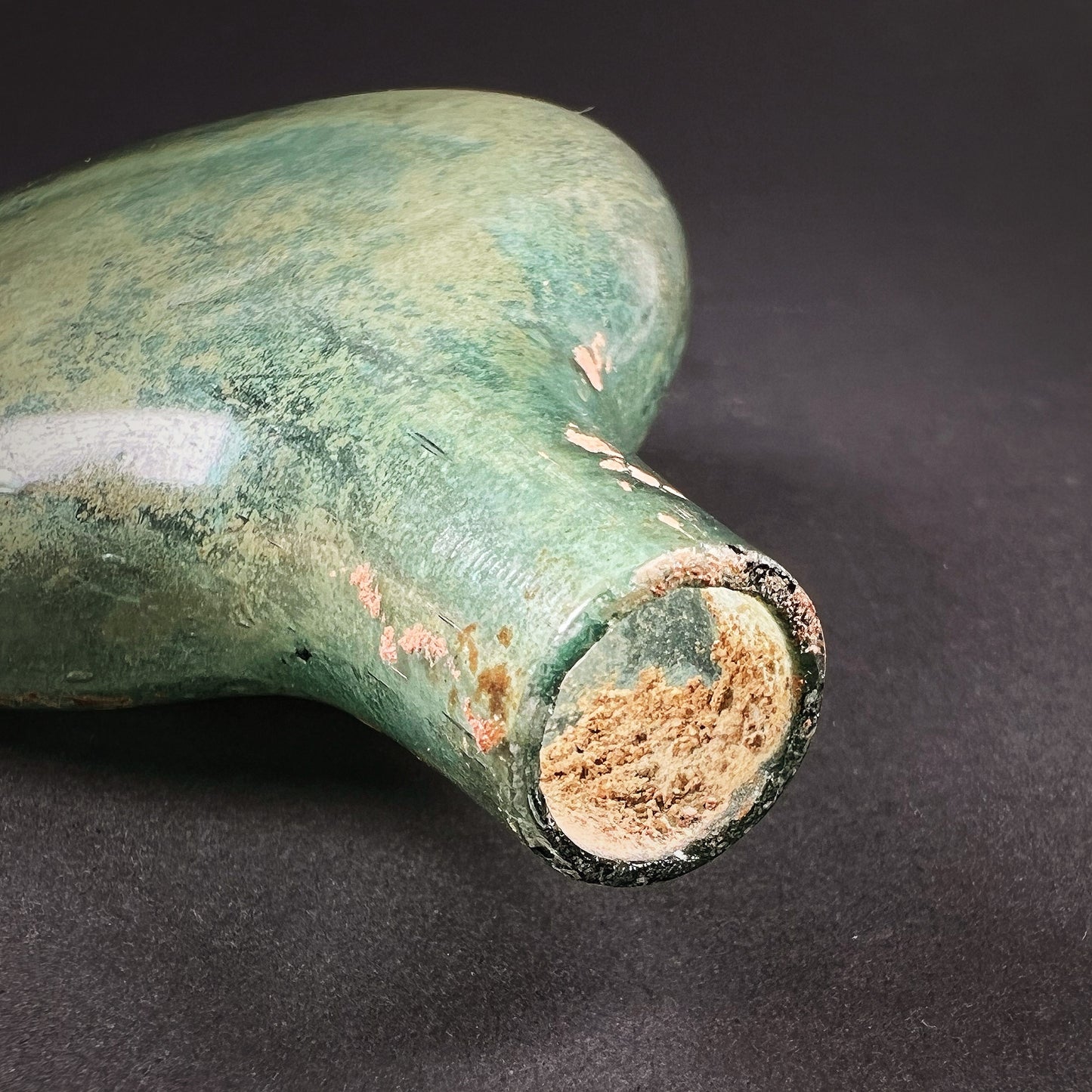
A beautiful and exceptionally well-preserved Roman lentoid flask, free-blown in translucent pale greenish-blue glass. The vessel is formed with a flattened spherical body leading to a gently tapering cylindrical neck, terminating in a neatly tooled and lightly flared rim. Tiny air bubbles, trapped within the glass during the blowing process, bear witness to its ancient manufacture, while the small flattened base retains its original pontil mark. Owing to its lentoid form, the flask is not designed to stand unsupported. Areas of delicate rainbow iridescence have developed across the surface, a natural result of centuries of burial.
Small glass vessels such as this were prized throughout the Roman world for storing costly perfumes, aromatic oils, cosmetics, medicinal preparations, and precious unguents. Unlike ceramic containers, glass was non-porous and chemically stable, preserving valuable contents without affecting their fragrance or composition. The narrow neck allowed liquids to be dispensed slowly and economically, making these elegant flasks ideal for expensive substances.
The introduction of glass-blowing during the 1st century BC revolutionized Roman glass production, enabling artisans to create vessels of increasingly refined forms with remarkable speed and efficiency. By the early Imperial period, free-blown glass had become one of the defining luxury industries of the Roman Empire. Flasks of this type are frequently recovered from settlements and cemeteries, where they often accompanied the deceased as grave goods, reflecting both their practical value and symbolic associations with personal care and the afterlife.
Elegant in form and beautifully preserved, this lentoid flask is an excellent example of Roman glassmaking at its finest. The graceful silhouette, attractive pale blue-green glass, and subtle iridescent weathering combine to create a highly desirable artifact that beautifully illustrates the technical sophistication and aesthetic refinement of the Roman glass industry.
Good condition. Wear consistent with age and use. Intact with light deposits and iridescence. Size approx. 8,4cm x 5,9cm x 1,9cm.
Provenance: From the collection of Harald Egon Stridh (b. 1935), Stockholm. Acquired through auction purchases in Sweden during the 1960s and 1970s.
For a similar example see:
Glass lentoid bottle, The Metropolitan Museum of Art, Accession Number: 74.51.67 (https://www.metmuseum.org/art/collection/search/239652)


-
Shipping
The shipment will be prepared in the course of 3-5 days and dispatched via Posti Group Oyj or purchased item(s) can be picked up from our shop during the store's opening hours (Tarkk’ampujankatu 4, 00140, Helsinki, Finland). Within the Finland, all items are shipped via Posti Group Oyj unless otherwise requested. We pack the items carefully and mainly in recycled materials because we want to save nature. You will receive the tracking number for your items by e-mail.
-
Returns
Returns and exchange will be accepted within fourteen days (14) of receipt at the purchaser’s cost to include freight and packaging. Items must be returned in the same condition as when they were shipped, and will not be accepted if damaged or altered in any way. Please inform us via email (info@gotanmaailma.fi) or by calling +358408408352 before sending. We do not accept returns more than 14 days after delivery.