

Sasanian Stamp Seal with Honey Bee Engraving
Sasanian Stamp Seal with Honey Bee Engraving
Couldn't load pickup availability
Sasanian Empire, c. 224–651 AD, Iran
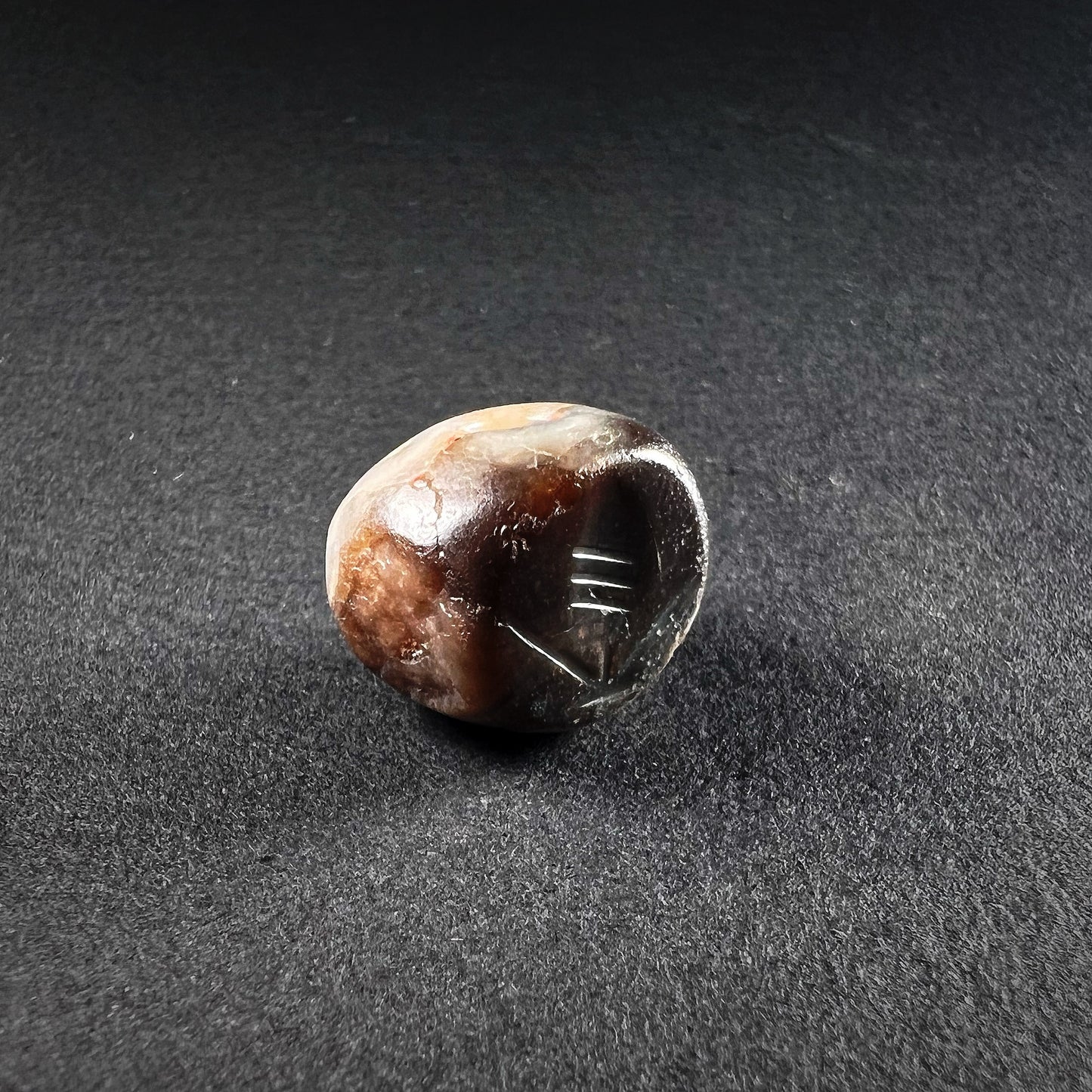
An exceptionally fine Sasanian stamp seal, skillfully carved from banded agate and fashioned in a distinctive ring-shaped form with an engraved oval bezel. The flattened bezel is finely incised with the stylized image of a honey bee, rendered in a characteristically simplified yet expressive manner. Two elongated, angled lines extend from the upper body to represent the insect's wings in flight, while the oval thorax is articulated by three neatly incised horizontal lines. The design was executed using short, confident blade cuts that effectively capture the bee's essential anatomical features through a restrained and highly stylized composition. The seal is pierced horizontally, allowing it to be suspended from a cord or worn as a personal ornament.
Stamp seals formed one of the most important expressions of personal identity throughout the Sasanian Empire. Used to authenticate documents, secure goods, and mark ownership, they served not only as practical administrative tools but also as symbols of status, authority, and individual identity. Today they constitute one of the largest surviving groups of Sasanian artifacts, providing invaluable insight into the artistic traditions, religious beliefs, and social life of Late Antique Iran.
The iconography of Sasanian seals is remarkably diverse, encompassing royal portraits, deities, mythical creatures, animals, celestial symbols, and geometric motifs. Animal imagery in particular often carried symbolic or protective significance, drawing upon both indigenous Iranian beliefs and much older artistic traditions inherited from Mesopotamia. Many Sasanian designs reveal the enduring influence of Babylonian and Assyrian glyptic art, although earlier naturalistic representations were transformed into the elegant, highly stylized visual language characteristic of Sasanian engraving. Through the use of simplified forms, rhythmic linework, and balanced compositions, engravers achieved images of remarkable clarity and symbolic power.
The honey bee itself was admired throughout the ancient Near East as a symbol of industry, order, fertility, and prosperity. Its appearance on a personal seal may have served as a protective emblem or conveyed qualities of diligence, abundance, and harmony associated with its owner.
A beautifully preserved and finely engraved example of Sasanian glyptic art, this elegant agate seal combines technical refinement with rich symbolic meaning, offering a compelling glimpse into the artistic sophistication and personal identity of the Sasanian world.
Excellent condition. Minor surface wear and small patches of encrustation are present, consistent with age. Size approx. 1,6cm x 1,4cm x 1,5cm.
Provenance: From the collection of Harald Egon Stridh (b. 1935), Stockholm. Acquired through auction purchases in Sweden during the 1960s and 1970s.


-
Shipping
The shipment will be prepared in the course of 3-5 days and dispatched via Posti Group Oyj or purchased item(s) can be picked up from our shop during the store's opening hours (Tarkk’ampujankatu 4, 00140, Helsinki, Finland). Within the Finland, all items are shipped via Posti Group Oyj unless otherwise requested. We pack the items carefully and mainly in recycled materials because we want to save nature. You will receive the tracking number for your items by e-mail.
-
Returns
Returns and exchange will be accepted within fourteen days (14) of receipt at the purchaser’s cost to include freight and packaging. Items must be returned in the same condition as when they were shipped, and will not be accepted if damaged or altered in any way. Please inform us via email (info@gotanmaailma.fi) or by calling +358408408352 before sending. We do not accept returns more than 14 days after delivery.