

Strand of Glass Beads
Strand of Glass Beads
Couldn't load pickup availability
Early to late 19th century, Ghana, West Africa
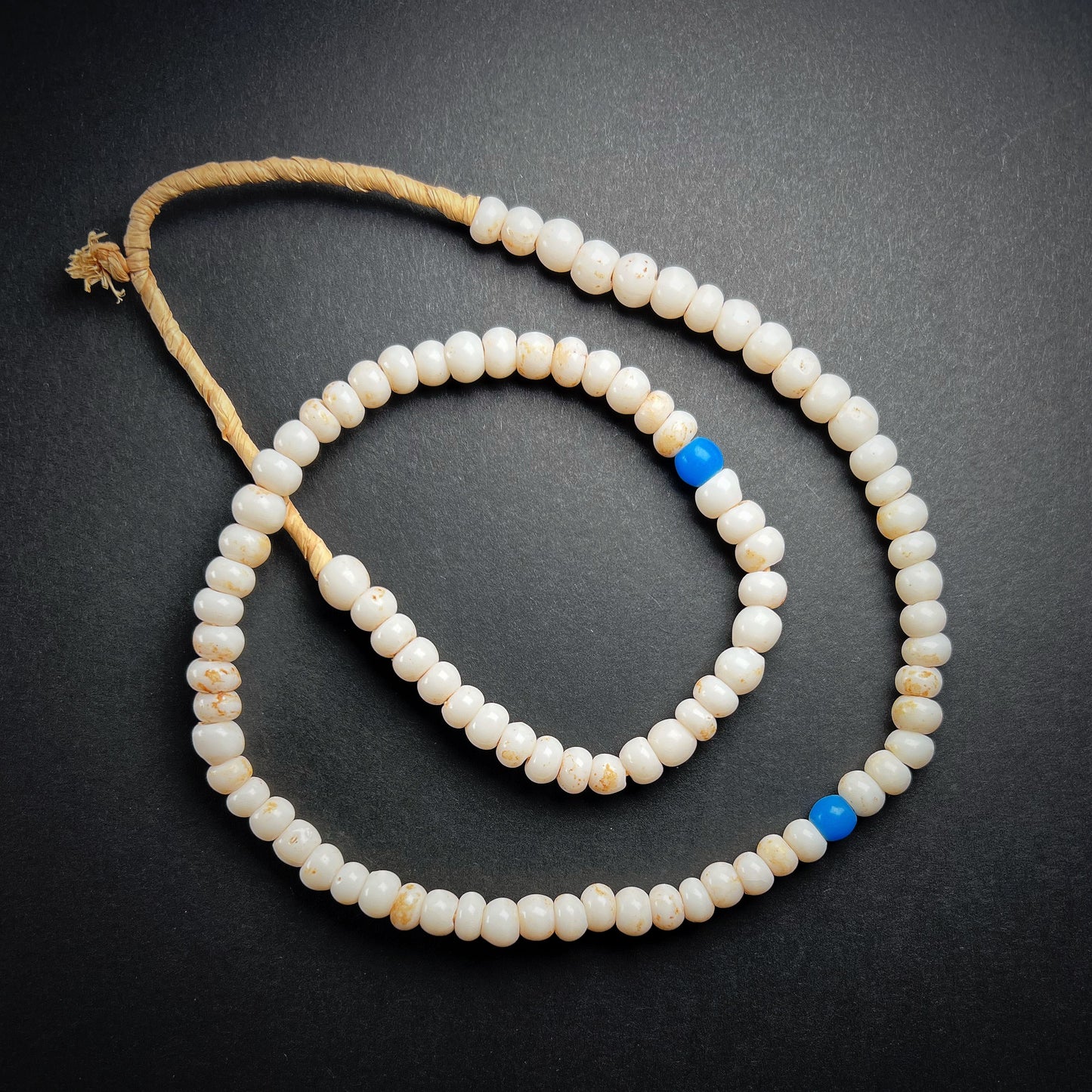
Superb strand composed of small, round and irregular 19th-century Bohemian glass trade beads, complemented by elegant white and blue padre beads. Re-strung on a modern cord. This harmonious assortment represents some of the most iconic bead types produced in Europe for the African trade.
Trade beads served as a crucial medium of barter within and between communities and are considered among the earliest forms of long-distance exchange. Some scholars even suggest that bead trading contributed to the development of language by encouraging increasingly complex social interaction.
The history of African trade beads expanded dramatically from the 15th century onward, when Portuguese ships began trading along the West African coast. Glass beads, along with other goods, were exchanged for gold, ivory, palm oil, and enslaved people. By the 18th and 19th centuries, beads had become a major form of currency, with vast quantities transported—often even used as ballast on outbound ships.
Among all beads circulating in Africa, Venetian examples from Murano dominated the market. At the height of production, up to seventeen factories on the island exported hundreds of tons annually. Glassmaking centers in Bohemia and the Netherlands likewise increased output to meet enormous African demand.
Their popularity reflects the high cultural value placed on adornment across many African societies. Because glassmaking was not widespread in Africa, beads became important symbols of wealth, prestige, and social identity. Many bead types were created specifically for African markets; European traders even studied regional color preferences and stylistic patterns to refine production. Among the hundreds of designs produced, certain categories became especially prized: millefiori, chevron (rosetta), Lewis & Clark, vaseline, striped melon, eye beads, and padre beads—the latter particularly favored by pastoralist groups in East Africa.
Trade beads continued to function as a currency until the late 19th century. Thereafter, their significance shifted toward aesthetic and cultural value. In Ghana and throughout West Africa, the quality, quantity, and variety of beads worn remain enduring indicators of status, heritage, and personal wealth.
Good condition. Wear commensurate with age and use. Beautiful old patina with minor chips and digs. Strand measures approximately 67.0 cm and includes 91 unique glass beads.
Provenance: Dutch private collection
References and further reading:
A Brief History of Glass Beads in Africa, African Odyssey (https://www.africanodyssey.co.uk/blog/a-brief-history-of-glass-beads-in-africa)
The BeadSite. (http://www.thebeadsite.com/welcome.html)
Collectible Beads: A Universal Aesthetic, Robert K. Liu, Ornament, Inc., 1995.
African Odyssey, A Brief History of Glass Beads in Africa.(https://www.africanodyssey.co.uk/blog/a-brief-history-of-glass-beads-in-africa)
-
Shipping
The shipment will be prepared in the course of 3-5 days and dispatched via Posti Group Oyj or purchased item(s) can be picked up from our shop during the store's opening hours (Tarkk’ampujankatu 4, 00140, Helsinki, Finland). Within the Finland, all items are shipped via Posti Group Oyj unless otherwise requested. We pack the items carefully and mainly in recycled materials because we want to save nature. You will receive the tracking number for your items by e-mail.
-
Returns
Returns and exchange will be accepted within fourteen days (14) of receipt at the purchaser’s cost to include freight and packaging. Items must be returned in the same condition as when they were shipped, and will not be accepted if damaged or altered in any way. Please inform us via email (info@gotanmaailma.fi) or by calling +358408408352 before sending. We do not accept returns more than 14 days after delivery.