

Strand of Vaseline Glass Beads
Strand of Vaseline Glass Beads
Couldn't load pickup availability
Early to late 19th century, Ghana, West Africa
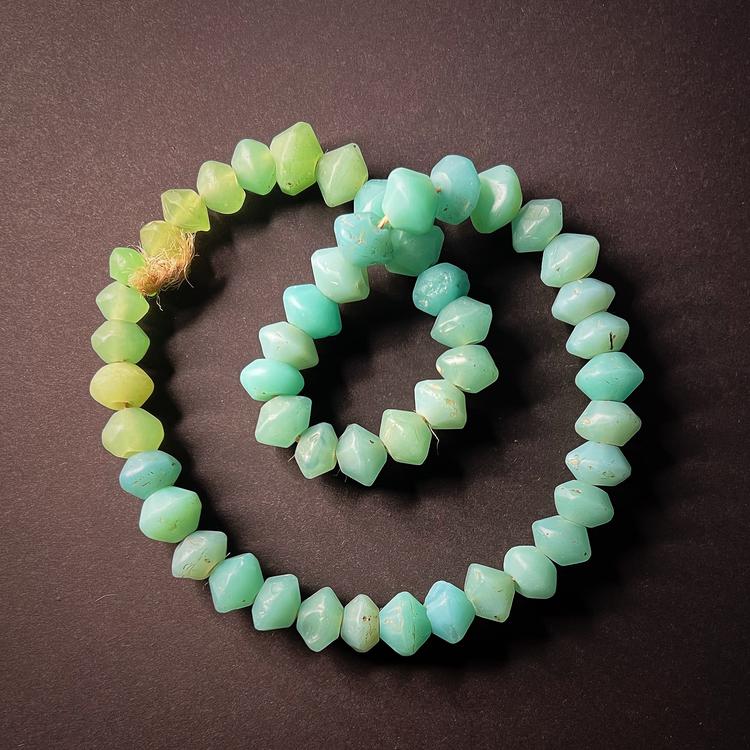
Exceptional strand of rare antique vaseline glass beads, originally produced in Bohemia (Czechoslovakia), displaying a beautiful seafoam-green hue. Now restrung on modern cord. Vaseline beads are characterized by their translucent green or jonquil tones, created through the addition of uranium salts to the glass mixture; under ultraviolet light they fluoresce a vivid green. Their distinctive faceted bicone form made them highly desirable in West African markets. The name “vaseline beads” comes from their soft, oily translucence reminiscent of petroleum jelly.
Trade beads served as a primary medium of exchange across West Africa for centuries and are considered among the earliest forms of long-distance barter. The widespread exchange of beads is thought to have even contributed to the development of complex human language. African trade bead history accelerated in the 15th century when Portuguese ships reached the West African coast, exchanging glass beads and manufactured goods for gold, ivory, palm oil, and enslaved people. At this time, glass beads formed a major component of the currency used in these transactions, and production in Europe—especially Venice—expanded rapidly to meet demand. Some beads were even used as ballast on outbound ships.
Venetian beads from Murano dominated the trade, with more than a dozen factories exporting hundreds of tons annually. Glass-bead manufacture in Venice, Bohemia, and the Netherlands flourished as African markets showed overwhelming preference for decorative items of high aesthetic and symbolic value. Glassmaking was not common in Africa, and beads became essential symbols of wealth, status, and cultural identity. Many bead types were created specifically for African consumers, informed by research into regional tastes and color preferences.
Among the most sought-after forms were millefiori, chevron (rosetta), striped melon, Lewis & Clark, eye beads, and the glowing vaseline beads represented here. Padre beads, imported from Germany and Czechoslovakia, became especially favored by pastoralist groups in East Africa. Trade beads continued to circulate as a form of currency until the late 19th century, after which their role shifted increasingly toward adornment and expressions of prestige. In Ghana and throughout West Africa, the quantity, quality, and style of beads worn still signal personal wealth, social standing, and connection to tradition.
Good condition. Wear commensurate with age and use. Beautiful old patina with minor chips and digs. Strand measures approximately 57.0 cm and includes 49 unique glass beads.
Provenance: Danish private collection. Acquired abroad and brought to Denmark in the 1960s.
References and further reading:
A Brief History of Glass Beads in Africa, African Odyssey (https://www.africanodyssey.co.uk/blog/a-brief-history-of-glass-beads-in-africa)
The BeadSite. (http://www.thebeadsite.com/welcome.html)
Collectible Beads: A Universal Aesthetic, Robert K. Liu, Ornament, Inc., 1995.
African Odyssey, A Brief History of Glass Beads in Africa.(https://www.africanodyssey.co.uk/blog/a-brief-history-of-glass-beads-in-africa)
-
Shipping
The shipment will be prepared in the course of 3-5 days and dispatched via Posti Group Oyj or purchased item(s) can be picked up from our shop during the store's opening hours (Tarkk’ampujankatu 4, 00140, Helsinki, Finland). Within the Finland, all items are shipped via Posti Group Oyj unless otherwise requested. We pack the items carefully and mainly in recycled materials because we want to save nature. You will receive the tracking number for your items by e-mail.
-
Returns
Returns and exchange will be accepted within fourteen days (14) of receipt at the purchaser’s cost to include freight and packaging. Items must be returned in the same condition as when they were shipped, and will not be accepted if damaged or altered in any way. Please inform us via email (info@gotanmaailma.fi) or by calling +358408408352 before sending. We do not accept returns more than 14 days after delivery.