
Sumatran Lampung Tampan Ship Cloth
Sumatran Lampung Tampan Ship Cloth
Couldn't load pickup availability
Abung, Pubian, or Paminggir People, c. 1850–1880 AD, Lampung, Sumatra, Indonesia
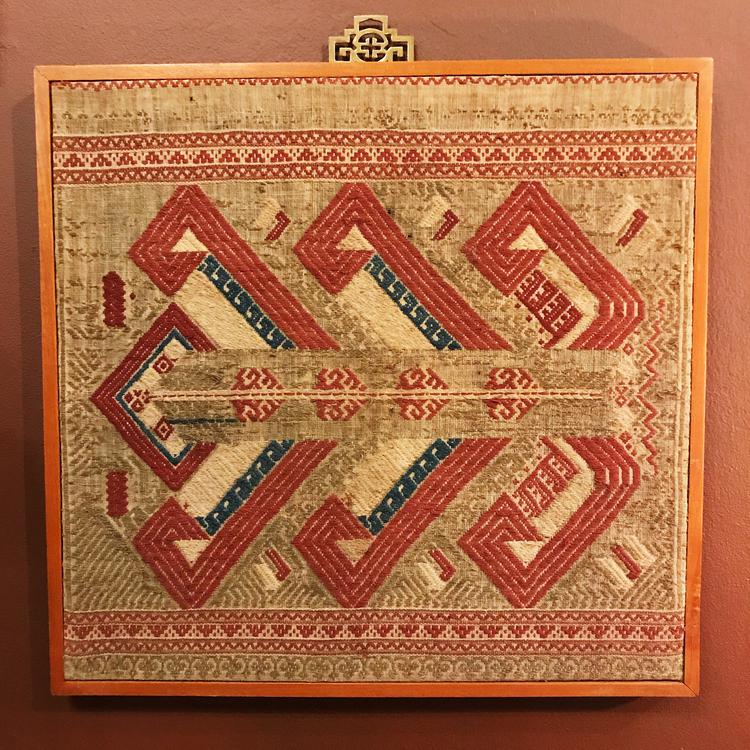
A superb ceremonial textile (tampan) from the Lampung region of southern Sumatra, masterfully woven with finely detailed human figures, mythical creatures, and ancestral shrines. The architectural form depicted likely represents the rumah poyang—ancestor houses built as memorials—characterized by pole-supported frames with towering conical roofs. The multi-tiered composition may symbolize cosmological or social hierarchies, reflecting the Lampung people’s sophisticated symbolic visual language. Although much of the original iconography is now lost, such textiles were powerful emblems of status, lineage, and spiritual authority.
Lampung, located at Sumatra’s southernmost tip below Palembang, is home to three interrelated ethnic groups: the Abung (Abung Siwo Mego) of the northern highlands, the Pubian (Pubian Telu Suku) of the eastern lowlands—collectively known as Pepadun—and the Paminggir (Saibatin) of the southern coasts. Each developed distinctive yet related weaving traditions.
The women of Lampung produced an extraordinary variety of textiles for both ceremonial and domestic use. The most celebrated are the long banner-like palepai, often depicting great ships carrying human and animal figures within sacred hierarchies. The smaller square tampan—such as this piece—served as condensed cosmograms, their compositions centered on the ship motif, symbolizing voyage, transition, and connection between worlds. These tampan were integral to life-cycle rituals—births, marriages, circumcisions, funerals, and status ceremonies—where they were displayed, exchanged, or gifted to mark pivotal moments in life and society.
Traditionally, Lampung dyes were entirely natural: red from sepang (Caesalpinia sappan), tamarind, areca nut, and henna; yellow from turmeric and tamarind; black from rambutan; brown from durian; and blue from indigo and lanson fruit. The yarns were preserved with citronella root, and betel leaves were used to prevent discoloration.
By the mid-19th century, Lampung’s prosperity through pepper cultivation fostered a flourishing of textile art. Yet the catastrophic eruption of Krakatoa in 1883 devastated many weaving communities—particularly around Kalianda—and, coupled with the region’s gradual Islamization, led to the decline of these ancestral traditions. By the 1920s, the production of fine Lampung textiles had virtually ceased. Today, surviving examples like this are rare and invaluable witnesses to the spiritual, artistic, and cosmological richness of Lampung’s vanished textile culture.
Good condition. Textile carefully stretched within modern double-sided frames. Age-related wear with areas of thread loss, small holes, and loose threads. Minor staining visible throughout. Size approx. 47,5cm x 49,0cm. (with modern frames)
Provenance: Finnish private collection
For a similar examples see:
Ceremonial cloth, Art Institute Chicago, Accession Number: 2002.103 (https://www.artic.edu/artworks/180423/ceremonial-cloth-tampan)
Ceremonial cloth, Yale University Art Gallery, Accession Number: ILE2006.4.112 (https://artgallery.yale.edu/collections/objects/111164)
The Metropolitan Museum of Art, Accession Number: 1990.335.22 (https://www.metmuseum.org/art/collection/search/316415)
References and further reading:
Textiles of Southeast Asia, Transition, Trade and Transformation, Robyn Maxwell, Australia: Oxford University Press, 1990, p. 113.
Traditional Indonesian Textiles, John Gillow, Thames & Hudson, 1995.
South Sumatran Ship Cloths, Mattiebelle S. Gittinger, The Bulletin of the Needle and Bobbin Club. Vol. 57, 1974, no. 1 & 2
The ship textiles of South Sumatra: functions and design system, Mattiebelle S. Gittinger, Bijdragen tot de Taal-, Land- en Volkenkunde, 1976, 132 (2/3): 207–227.
Sumatra, Crossroads of Cultures, Ed by Francine Brinkgreve & Retno Sulistianingsih, KITLV Press, 2009.
Splendid Symbols: Textiles and Tradition in Indonesia, Mattiebelle S. Gittinger, Washington DC: The Textile Museum, 1979, p. 157.
-
Shipping
The shipment will be prepared in the course of 3-5 days and dispatched via Posti Group Oyj or purchased item(s) can be picked up from our shop during the store's opening hours (Tarkk’ampujankatu 4, 00140, Helsinki, Finland). Within the Finland, all items are shipped via Posti Group Oyj unless otherwise requested. We pack the items carefully and mainly in recycled materials because we want to save nature. You will receive the tracking number for your items by e-mail.
-
Returns
Returns and exchange will be accepted within fourteen days (14) of receipt at the purchaser’s cost to include freight and packaging. Items must be returned in the same condition as when they were shipped, and will not be accepted if damaged or altered in any way. Please inform us via email (info@gotanmaailma.fi) or by calling +358408408352 before sending. We do not accept returns more than 14 days after delivery.